
Bail in the borrowers, too
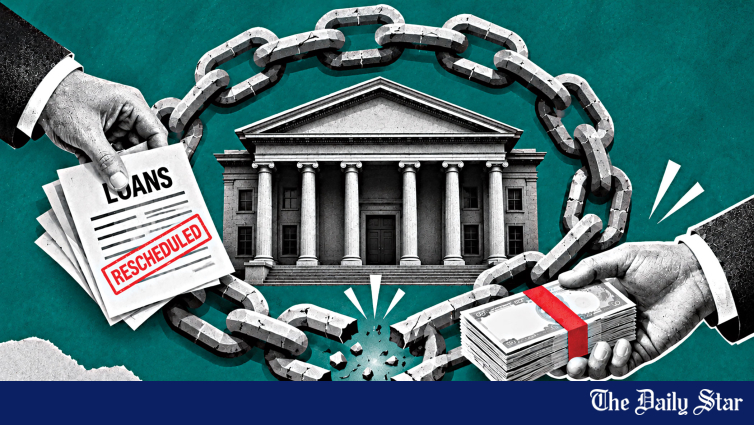
Bangladesh Bank has shown that shareholders can be asked to bear losses first. Applied through
loan rescheduling, the same principle can help resolve corporate bad loans
Published : 30 November 2026
•
Updated : 29 November 2026, 22:26
In November 2025, Bangladesh Bank resolved five Islamic banks (Exim, First Security Islami, Global Islami, Social Islami and Union) and merged them into Sammilito Islami Bank. In the process, it reduced their paid-up capital, Tk 58.2 billion ($467 million) at face value according to stock exchange data, to zero, so that shareholders bore the losses first and the government injected Tk 200 billion ($1.6 billion) of new capital only thereafter. In September, parliament removed a provision that would have allowed former shareholders to apply to reclaim such banks. This was a “bail-in” in the full sense of the term: hard on investors, but the right decision. The same principle, however, has not yet been applied to the other side of the banks’ balance sheets, namely their borrowers. It should be, with care, by requiring that the most generous loan rescheduling come with “new money” from non-bank sources.WHAT HAS CHANGEDOn August 31, Bangladesh Bank extended its special rescheduling facility for a second time, allowing borrowers owing Tk 10 billion ($80 million) or more to repay over as long as 15 years, including a two-year grace period. The reasons are understandable. Companies have faced gas shortages and higher oil prices; the taka has moved from Tk 85.80 per dollar at the end of 2021 to about Tk 124.75 today, and borrowing costs have been high. The authorities rightly want to protect jobs and exports. However, time alone rarely restores a company whose debts exceed what its business can carry. When rescheduling is granted repeatedly and without conditions, the definition of a good loan shifts from a “loan that pays” to a “loan that is rescheduled.” THE SCALE OF THE PROBLEMAt the end of June 2026, defaulted loans stood at Tk 6,066 billion ($48.6 billion), or 32.78 percent of bank lending, according to Bangladesh Bank. The central bank’s Financial Stability Report 2025 also records a broader measure of distressed assets, which adds loans rescheduled and now performing, loans held up by court stay orders, and loans already written off; that measure reached Tk 10,918 billion ($87.5 billion) at the end of 2025. Bangladesh Bank rightly cautions that this broader figure is not a measure of non-performing loans, since many rescheduled loans are being repaid. Nonetheless, in my judgment, it shows how much of the loan book now depends on forbearance. Moreover, about 300 borrowers rescheduled or restructured nearly Tk 1,000 billion ($8.0 billion) under the package introduced in September 2025, The Business Standard reports. The default ratio fell to 30.60 percent in December 2025 and then rose to 32.26 percent in March 2026. The newspaper attributes part of the rise to borrowers who used the facility and failed to repay, while Bangladesh Bank notes that most remain within their grace period. Because most of these borrowers have not yet begun full repayment, the terms Bangladesh Bank sets now can still change the outcome.HOW IT WOULD WORKA borrower seeking the most generous terms (a long tenor, a long grace period and a minimal down payment) would bring in new money equal to an agreed share of the rescheduled debt, calibrated by Bangladesh Bank by size and sector. The owners could provide the money themselves and keep full ownership on the one hand, or bring in outside investors, through equity or through convertible or subordinated debt ranking below the banks’ secured loans, on the other. If that debt converts, the owners are diluted. If dilution is the price of outside capital, so be it.
The arrangement would be consensual and agreed out of court, between the borrower, its banks and any new investors. It need not be adversarial, because it helps every party: the company gains capital and time, the banks gain a sounder borrower, new investors gain a share of the recovery, and the owners keep the choice of how to fund it. Nothing is confiscated, and ordinary rescheduling remains available on ordinary terms. The condition can begin with the largest accounts, which Bangladesh Bank already reviews case by case. To prevent roundtripping, the new money must be verified as genuinely new, through beneficial-ownership and source-of-funds checks; it must not be borrowed from the banking system; and it must stay in the business rather than repaying related parties. Any breach would return the loan to classified status, with full provisioning.
The banks must contribute too. Where a company’s debt exceeds what its business can carry, the banks should separate the loan into a sustainable portion, rescheduled on commercial terms, and a remainder that is written down or converted into an instrument that shares in any recovery. Economists call the alternative “debt overhang”: when old debt absorbs most of the gain from new investment, no one will invest. Conversely, when the banks give time, accept a fair write-down and give new money priority where needed, outside capital has room to earn a return.IMPLEMENTATION CAN BE QUICKNone of this requires new institutions. In my view, the state already has the instruments, with three regulators acting within their existing mandates. Bangladesh Bank can write the new-money condition into its rescheduling rules. The Bangladesh Securities and Exchange Commission (BSEC) can provide a fast route for approving the convertible and subordinated instruments that listed borrowers would issue. The National Board of Revenue (NBR) can clarify the tax treatment of write-downs and conversions, so that tax does not become an obstacle to restructuring. With coordination by the Ministry of Finance, these steps could be taken by circular, rule and notification within months rather than years. Because the arrangement would be consensual and out of court (no owner is compelled to accept new money, and ordinary rescheduling remains available), I do not expect it to infringe any citizen’s rights. That judgment should nonetheless be tested. Legal experts should examine whether any element would conflict with the constitution or with existing banking, company, securities or tax law, and where they find a conflict or a gap, parliament should pass or amend the necessary legislation so that the framework rests on secure legal ground.SECONDARY BENEFIT: LESS PRESSURE ON INFLATIONBangladesh Bank’s uncollateralised liquidity support to weak banks stood at Tk 760 billion ($6.1 billion) in June 2026, according to the World Bank, and the International Monetary Fund has cautioned that such support, when unsterilised, is likely to add to inflation and foreign exchange pressure. If private capital helps borrowers pay their banks, weak banks will need less central bank money, and Bangladesh Bank will have less reason to create it. The effect on prices would be indirect.
In conclusion, Bangladesh Bank has already asked the owners of failed banks to bear losses first. Asking the same of large borrowers, through the rescheduling rules and with the banks sharing the burden, would bring private capital into the recovery and leave the public to pay last. Bangladesh Bank, BSEC and the NBR should therefore act together to make new money the condition for the most generous rescheduling, before the current round of grace periods comes to an end.(US dollar equivalents use Bangladesh Bank’s inter-bank weighted average rate of Tk 124.75 per dollar, as published on 23 November 2026.)The author is the founder of ASPEN Capital Solutions LLC in New York.