
Govt plans four types of bonds to reduce reliance on bank borrowing: Khosru
Highlights:
- Govt plans dollar, Panda, Samurai and Sukuk bonds to diversify financing
- World Bank interested in supporting bank recapitalisation
- Hong Kong-based private equity fund planned to turn around struggling banks
- Govt targets 5,000MW of renewable energy in the next 12 months
- NBR to be fully digitised, with AI-based systems, within 2-3 months
- PSC negotiations for oil and gas exploration expected to conclude in 2-3 weeks
- Govt aims to expand Family Card coverage to 2 crore families
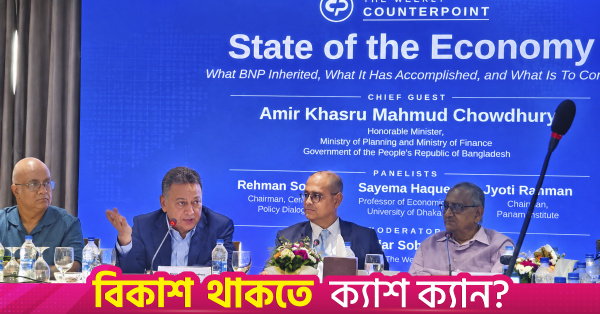
Finance Minister Amir Khasru Mahmud Chowdhury has said the government plans to issue four types of bonds – dollar, panda, samurai and sukuk – to reduce its reliance on bank borrowing to finance public expenditure and development projects.
Through these instruments, the government aims to mobilise alternative financing from international and domestic capital markets and build a new public financing architecture.
The finance and planning minister said the government was taking initiatives to raise funds from alternative sources while reducing its dependence on bank loans. It is also planning to establish a private equity fund for the stock market.
He made the remarks at an event organised by The Weekly Counterpoint in Dhaka today (28 November), where he discussed the current state of the economy, the economic conditions when the government took office, and various measures undertaken to facilitate recovery.
The minister said that when the BNP government assumed office, the economy was grappling with a heavy debt burden, high inflation and a crisis in the banking sector. Government borrowing over the previous five years had exceeded the total borrowing of the preceding 20 years, he said. As a result, the budget had to allocate more than Tk1 lakh crore solely for interest payments on government debt.
Explaining the alternative financing plans, he said the government was considering issuing dollar bonds in international markets, panda bonds in China, samurai bonds in Japan and sukuk to raise Shariah-compliant financing. The funds would be used to finance government expenditure and development activities.
The minister said a separate Debt Management Department had been established to bring greater transparency to government borrowing. The initiative aims to ensure more transparent disclosure of the volume, sources and repayment details of public debt.
To ensure cost-effectiveness and efficiency in development projects, the government has introduced four conditions for approving new projects. These include ensuring value for money, returns on investment, employment generation and environmental safety.
Many old and ineffective projects have been cancelled for failing to meet these criteria, the minister said.
The minister added that Bangladesh was making repayments on foreign loans on schedule and had no overdue payments.
World Bank interested in bank recapitalisation programme
Finance Minister Amir Khasru Mahmud Chowdhury said the World Bank had expressed specific interest in supporting the country's bank recapitalisation programme.
The government is also seeking to mobilise private equity investment through a fund being established in Hong Kong to attract investors capable of turning around struggling banks.
Addressing concerns over the banking sector, the minister said the government had assured depositors that their money was safe and that no haircut would be imposed on their deposits. These assurances helped prevent bank runs and maintain positive net deposit growth, he said.
NBR reforms, tax collection up 12%
On revenue administration, the minister outlined plans to separate tax policy formulation from tax collection to reduce policy-related corruption and improve institutional accountability.
Expert groups will be entrusted with formulating tax policies, while tax collection activities will remain separate.
He said he was directly overseeing activities at the National Board of Revenue (NBR) to ensure the implementation of reforms. The government plans to introduce full digitisation and automation, including artificial intelligence-based systems, within the next two to three months.
Tax collection has already increased by 12%, according to the minister. The government ultimately aims to raise the tax-to-GDP ratio to 45%, he added.
Govt targets 5,000MW renewable energy in a year
On the energy front, the government is targeting the addition of 5,000 megawatts of renewable energy capacity over the next 12 months, with an ambition to raise it to 10,000MW.
The minister said tax exemptions and other relief measures had been introduced as temporary arrangements to address the country's power shortages while longer-term energy solutions were being pursued.
The government is also advancing domestic coal exploration and coal-based power generation projects, including the Matarbari project and plans involving two to four additional mines.
He claimed that the quality of Bangladesh's domestic coal was three times better than that of coal from Indonesia and India.
Negotiations on Production Sharing Contracts (PSCs) for oil and gas exploration are also nearing completion and are expected to be finalised within the next two to three weeks, he said.
Govt plans sweeping capital market reforms
Turning to capital market reforms, the minister said the government wanted to transform the stock market into a transparent, automated system with real-time operations.
The proposed reforms also aim to reduce the company listing process to three months and curb market manipulation.