
Imported inflation beyond govt control: finance minister
Published : 29 November 2026
•
Updated : 29 November 2026, 14:22
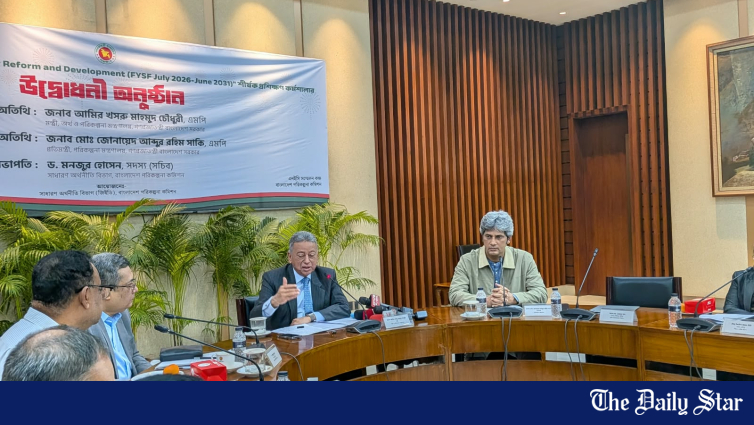
Finance and Planning Minister Amir Khosru Mahmud Chowdhury speaks at a workshop, titled “Reform and Development on Five-Year Strategic Framework: July 2026-June 2031”, at the Planning Ministry in Dhaka today. Photo: Ministry of Finance
Food inflation has eased, but the government has no control over imported inflation driven by global market dynamics, said Finance and Planning Minister Amir Khosru Mahmud Chowdhury today.
High international prices for gas, fertiliser and essential commodities are driving up import costs, he said at a workshop, titled “Reform and Development on Five-Year Strategic Framework: July 2026-June 2031”, at the Planning Ministry in Dhaka.
“We are importing inflation. I have no control over this. However, we do have some control over domestic factors,” said Khosru, adding that a significant amount of foreign currency is spent on importing even a single lot of gas, which affects prices across the board.
However, food inflation edged down to 6.4 percent in October this year from 7.08 percent a year ago following a reduction in taxes on some essentials.
He said the Bangladesh Bureau of Statistics (BBS) had been instructed to publish accurate data free from government influence, adding that plans were underway to set up an online open lab at the BBS for researchers.
Khosru said economic growth would remain sluggish for some more time as the economy passes through a stabilisation phase.
He urged people to accept the current economic reality and said the economy was expected to ‘take off’ by the fourth year.
Khosru also talked about the problems in the banking sector, saying the massive liabilities created in the past could not be resolved overnight and must be addressed gradually.
“While there were initial fears of a bank run, public confidence has returned and deposits are rising following assurances regarding depositors’ funds,” he added.
The minister said efforts were underway to bring fundamentally strong companies to the stock market. The stock market was turned into a 'casino' in the past, but indicators showed positive changes following the appointment of an apolitical and independent regulatory commission, he said.
He cited positive responses during the prime minister’s recent Wall Street meeting with 17 institutions managing $36 trillion in funds and said there was growing confidence among foreign investors.