
Intensive cultivation of Venami started, more than 80 tons of shrimp were found per hectare

For the first time in the country, a farm in Cox's Bazar has started cultivation of high-yielding species of Venami shrimp in a very intensive manner. The company recently harvested their farmed shrimp for the first time. Seamark (BD) Limited has managed to produce more than 80 tonnes of shrimp per hectare. Only about five hundred kg of shrimps are available in traditional farming.
People involved in the shrimp sector say that Venami shrimp farming is very expensive in a highly intensive manner. This cultivation has to follow scientific process, hence its management is also different. However, if the cultivation of this method is increased, it is possible to increase the shrimp export income several times. In addition, shrimp can be sold at a low price in the local market.
Venami is a high yielding shrimp. It is now widely cultivated all over the world for its high yield as well as disease resistance. At present, 80 percent of the shrimp produced worldwide are of the Venami variety. Experimental cultivation of Venami started in the country in 2019. After four years of various experiments, the government allowed the commercial production of this shrimp to begin. After that, several entrepreneurs of the country took the initiative of cultivating venami in traditional and semi-intensive methods. However, Seamark (BD) Ltd. has undertaken intensive farming for the first time.
How the farm is built
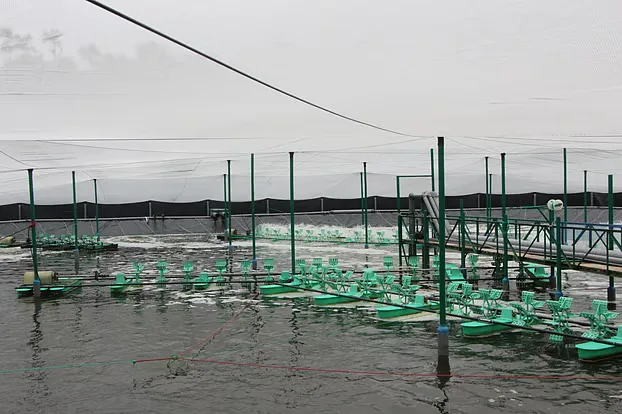
Seamark already had a hatchery along Marine Drive in Ukhia. It has been scientifically developed for Venami cultivation. The reconstruction of the farm started in January 2023. Seamark invested about 25 crore rupees for this. The 12 acre farm has three culture ponds, 32 nursery ponds and 16 quarantine ponds.
All modern scientific techniques are used in the project. For this, technology has been brought from Thailand, Germany, United Kingdom and Singapore. Venami is cultivated in salty sea water. For this, water from the Bay of Bengal is brought directly and supplied to the ponds after purification. Through this, all types of bacteria and virus contamination that comes with sea water can be prevented. The farm has several types of ponds, which are protected from pollution and environmental uncertainty.
This reporter of Prothom Alo went to see the Venami farm of Seemark last Tuesday. There is a very strict biosecurity system at the farm. Cars were sprayed and everyone had to enter the farm clean. Apart from this, the farm has a laboratory, which has facilities for physicochemical and microbiological testing of water and shrimp. No banned chemicals and antibiotics are used in the farm. In addition, wastewater is not released into the environment without treatment. Engineers and technicians from Thailand's Charoen Pokphand Foods (CPF) worked on the project. Venamir molecules (newborn foals), food and several technologies were also brought from the CPF.
Farm quality control officer Salahuddin Ahmed said that Venami species are generally pathogen-tolerant. However, it can be infected with viruses or bacteria. This is why there is such a security system. He further said that after bringing the cells from abroad, they are reared in the nursery pond for 15 days. They are then fed into culture ponds. After 60-120 days, the shrimp are removed from the pond for sale.
how much production
Venami cultivation is generally done in four ways – traditional, semi-intensive, intensive and ultra-intensive. Among them, Seamark is producing Venami in Ukhia in a very intensive manner. A system known as super intensive can grow up to 330 shrimp per square meter, while the traditional system can grow a maximum of 5 shrimp per square meter. Apart from this, the survival rate of shrimp in the intensive system is about 90 percent.
People related to the shrimp sector said that if cultivated in the farm in the traditional way, about 500 kg of bagda shrimp can be obtained per hectare. And with semi-intensive cultivation it is possible to produce up to 5-6 tons of Bagda per hectare. There 8–10 tonnes of Venami shrimp per hectare can be obtained in semi-intensive systems. And if cultivated in a very intensive manner, it is possible to produce 80-100 tons of Venami shrimp per hectare. That is, the production rate of Venami is very high.
MU C Foods Limited has cultivated Venami in semi-intensive method in Khulna. Shyamal Das, managing director of the organization, told Prothom Alo that many farmers are now turning to semi-intensive venami cultivation. Although the yield is high in intensive methods, it requires large investment and expertise. However, if the government provides policy support, intensive farming will increase.
Iqbal Ahmed, chairman of Seamark Group, said that Venami is like broiler chicken or high-yielding rice. As our population is high and land is scarce, there is no alternative to such high-yielding shrimp farming. The rest of the world is also moving in that direction.
Export growth potential
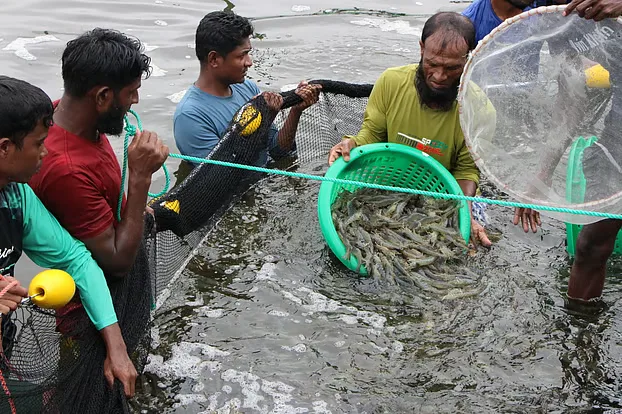
Seamark released the Venami molecule in the first pond for commercial cultivation in April this year. After 80 days it is taken up for sale. At this time, 40 prawns were found per kg. The first shipment of Venami from Seamark's Ukhia farm goes to Seamark's processing plant in Chittagong. From there after processing it will be exported to UK. A few consignments of venami produced in Khulna region, however, have already been exported.
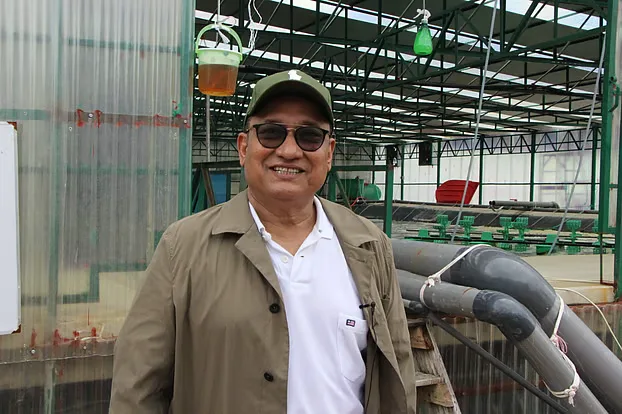
Seamark Group Chairman Iqbal Ahmed has been associated with the shrimp industry for about 25 years. This businessman has also received gold medal 9 times for export of processed shrimp. He said, Bangladesh's shrimp export index has gone down a lot. Many institutions in this sector have closed down. As a result, it is possible to reopen these institutions through the production of Venami shrimp.
Iqbal Ahmed also said, "Our neighboring countries have already progressed well in venami cultivation. If we can start now, we can capture the global market. However, it will not be enough if only two or four people cultivate. For this, initiatives should be taken from the highest policy-making level of the government. If the government supports and the farmers are encouraged in scientific farming, it will be possible to exceed 10 billion dollars in export income in this sector in the next five years.
🌐 This English version was automatically translated from the original Bangla.