
Kerb dollar tops Tk 130 ahead of December demand
Published : 30 November 2026
•
Updated : 29 November 2026, 22:33
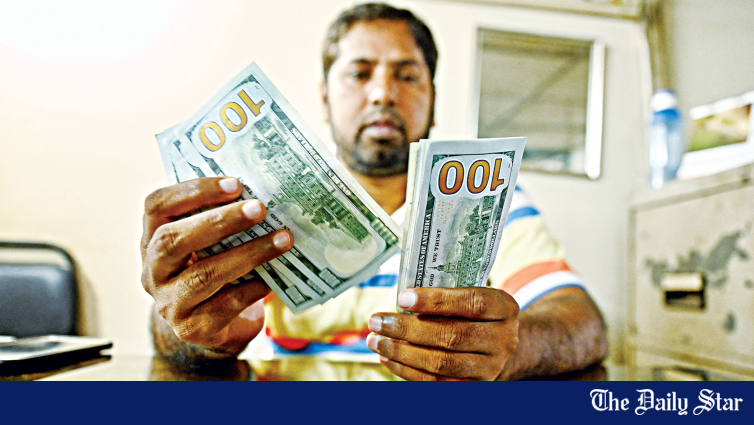
The US dollar has crossed Tk 130 in the kerb market amid rising demand ahead of December, as more people prepare for overseas holidays, medical treatment and education expenses.
Money changers in Motijheel and Gulshan sold the dollar at Tk 130.50 to Tk 131 yesterday, while buying it at Tk 129.60 to Tk 130. On Saturday, the selling rate was Tk 128 to Tk 129.
MS Zaman, president of the Money Changers Association of Bangladesh, told The Daily Star that the dollar traded at Tk 129.30 to Tk 130.30 yesterday.
Zaman, who owns Zaman Money Changing House, said the dollar was gaining value across the market, although money changers were unsure about the exact reason behind the increase.
According to the association’s website, member establishments must display the dollar rate set by the association on their rate boards. Those that fail to follow the directive or sell dollars above the maximum rate of Tk 130.30 face strict legal action, including financial penalties.
However, the association regularly updates the maximum selling rate.
A money changer in Motijheel, speaking on condition of anonymity, said demand for dollars usually increases ahead of December, pushing up prices in the open market.
Arief Hossain Khan, executive director and spokesperson of Bangladesh Bank, also said dollar prices in the kerb market tend to rise around this time of the year.
“Many people travel abroad for holidays in December, while some go overseas for medical treatment. People also pay tuition fees for studying abroad during this month. As a result, demand for foreign currency rises slightly,” he told The Daily Star.
However, he said some money changers deliberately charge higher rates, adding that the central bank takes action when such irregularities come to its attention.
A few days ago, Bangladesh Bank capped the selling rate of cash foreign currencies to stabilise the market and protect customers. Under the new rule, banks cannot sell foreign currency cash above their Bills for Collection (BC) selling rates.
Banks are currently quoting Tk 125.05 to Tk 125.40 per dollar as the BC selling rate. However, they had previously charged Tk 1 to Tk 1.50 more for cash foreign currency.
Customers, however, have alleged that banks are still not selling foreign currency at the prescribed rates.
Rafiqul Islam, who was waiting to buy dollars from a money changer in Motijheel yesterday, told The Daily Star that he was planning a family trip to Thailand and wanted to carry US dollars instead of Thai baht.
After failing to buy dollars from a bank, he turned to a money changer but was surprised by the price quoted.
A treasury head of a private commercial bank, requesting anonymity, said the decision to cap cash foreign currency selling rates was not good for the foreign exchange market.
“Most banks source cash foreign currencies from travellers and a few other channels, so their stocks are limited,” he said. “The move will put pressure on banks as the kerb market rate is much higher than the rates offered by banks.”IMPORT DEMAND ADDS TO PRESSUREMeanwhile, banks have also raised their dollar selling rates for importers amid higher import costs driven by rising fuel prices and ahead of Ramadan.
Although the interbank dollar exchange rate has remained unchanged at Tk 124.75 for the past week, banks are quoting different rates for importers.
Yesterday, private commercial Pubali Bank quoted Tk 125.50 for selling the US dollar and Tk 124.20 for buying it. State-run Sonali Bank quoted Tk 125.25 for selling and Tk 124.25 for buying, according to data.
Bangladesh Bank data show that letters of credit (LCs) opened for consumer goods imports rose 20.30 percent to $1.93 billion during July to September of the current fiscal year.
LCs for intermediate goods imports increased 29.34 percent to $1.29 billion, while those for petroleum imports surged 72.15 percent to $3.92 billion.
To meet the rising demand for foreign currency, Bangladesh Bank has recently injected dollars into the market, putting pressure on the country’s foreign exchange reserves.
As of November 24, foreign exchange reserves stood at $29.53 billion under the BPM6 method, down from $30.12 billion on November 10, according to central bank data.