
Economy slows further, worries traders for five reasons
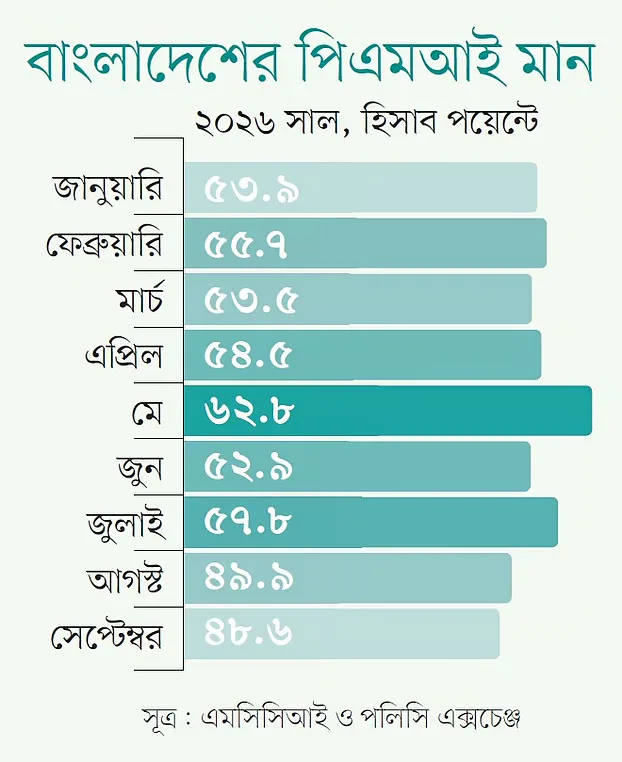
Business in the industrial manufacturing sector slowed in the country last September as new purchase orders for goods, production, stocks of raw materials and finished goods and imports fell. At this time, the service sector could not get out of the contraction trend. And the construction sector has also gone into contraction again. Only the agricultural sector was expanding. As a result, the country's overall economy slowed further last month due to weakness in the manufacturing, construction and service sectors. This information has emerged in the assessment of PMI.
Purchasing Managers' Index or PMI is a monthly indicator of economic growth. Last month's PMI released today Thursday. Information on the position of this index is communicated through a press release. The PMI assesses the economy going through ups and downs for two years. Last September, the PMI value dropped to 48.6 points. The PMI value in August was 49.9 points.
The PMI is jointly developed by the Metropolitan Chamber of Commerce and Industry (MCCI) and the Policy Exchange, an organization of businessmen and entrepreneurs.
The value of this index is determined based on the opinion of the top executives of 400 private companies in the main sectors of the economy: agriculture, business, construction, manufacturing and services. In the preparation of the index, information is collected from various institutions including purchase of raw materials, purchase orders of products, employment. Basically the PMI value is measured between zero and 100 points. Index values above 50 indicate expansion of the economy and below 50 indicate contraction.
Businessmen surveyed by the PMI last month cited five reasons for their concerns about business and the economy. These are fuel price hikes, raw material and operational cost increases, weak consumer purchasing power, electricity and gas shortages and bank credit constraints. Traders say the overall economic uncertainty has made it difficult to plan ahead for business. They believe that if the pressure of fuel and other expenses continues, the situation may deteriorate further.
According to the notification, among the businessmen who participated in the survey, there is a cautious picture in terms of business confidence. Future prospects will largely depend on growing domestic demand, reliable energy supply, easy access to finance and easing cost pressures, say traders. However, some firms have expressed hope for an improvement in business activities in the coming months with confirmed orders, reliable buyers and the prospect of increased demand in the coming winter and business season.
The manufacturing PMI fell by 2.6 points to 44.8 last month, which contributed to the fall in the PMI. Last August, the PMI value of the manufacturing sector was 47.4 points. Similarly, the PMI value of the construction sector decreased by 3.8 points to 48.5 points last month.
Apart from this, the service sector has been in contraction phase for two consecutive months. Last month the PMI value of the sector fell to 49 points. New businesses and business activities in this sector have returned to contraction. The contraction in employment slowed slightly. On the other hand, the agricultural sector continued to expand for 13 consecutive months. Although the PMI value of this sector decreased by 1.3 points compared to the previous month to 55.2. Expansion in new businesses, business activities and employment in the sector has slowed.
Policy Exchange Bangladesh Chairman M Masrur Riaz said in a statement about the PMI values, the September PMI shows that the economy of Bangladesh is still under pressure due to the weakness of the manufacturing, construction and service sectors. The continued expansion of the agricultural sector has maintained some stability in the economy. Masroor Riaz also said that marginally positive expectations across all sectors are creating a promising base for economic recovery. Strengthening domestic and export demand, ensuring reliable energy supply, reducing financing constraints and controlling inflationary pressures are important to restore the pace of economic activity, he said.
🌐 This English version was automatically translated from the original Bangla.