
Relief on supply of fasting products, worry on soybean oil
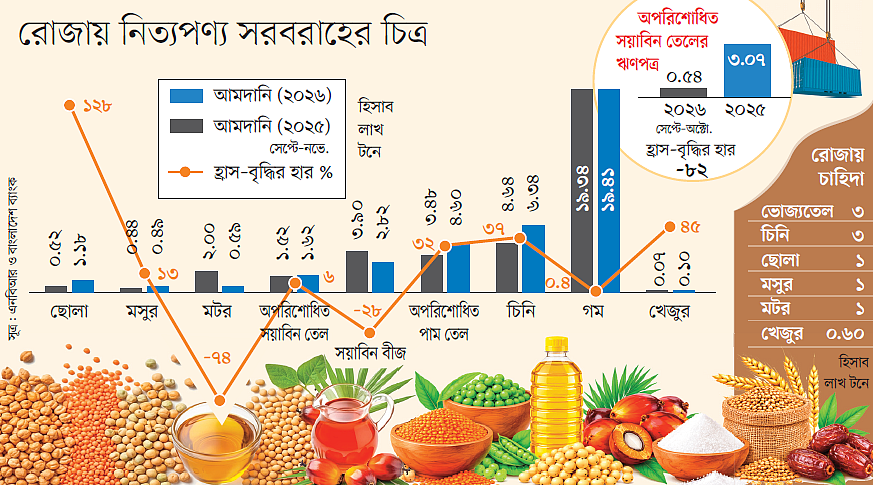
There are two months left before the start of the holy month of Ramadan. Meanwhile, imports of most products that are in high demand during fasting have increased. Loans are also being opened. Analyzing the trend of import and credit, it is seen that the supply situation of almost all products except soybean oil is satisfactory. A supply shortfall could occur if credit opening rates do not increase to meet the increased demand for soybeans due to winter.
An analysis of data from the National Board of Revenue (NBR) and Bangladesh Bank shows that the import of chickpeas, lentils, sugar, palm oil, wheat and dates has increased in the three months from September to November 26 compared to the same period last year. On the contrary, imports of crude soybean oil and soybean seeds and credit opening decreased. Traders said that despite the decrease in the import of peas, there is little risk of supply shortage in this product.
According to the Bangladesh Trade and Tariff Commission, the demand for chickpeas, lentils and peas during the fasting month is about 1 lakh tonnes. The demand for sugar and edible oil is about three lakh tons.
Most of the demand for these products has to be met by imports. A part of the products imported from November will be supplied to the fasting market besides meeting the regular demand.
Traders say that the supply situation for most of the commodities except two is comfortable. There is an opportunity to extend the supply till January of products which imports are still low. On the other hand, consumers are likely to get benefits due to the reduction in the duty rate of dates well before Roja. In the meantime, the release of dates at low duty rates has also started.
Mostafa Kamal, chairman of Meghna Group of Industries (MGI), one of the largest industrial groups that process daily goods, told Prothom Alo that the import of products such as sugar, wheat, palm oil and pulses has increased due to the government's provision of loan facilities for the import of fasting products. Supply will increase before fasting. As a result, there should not be a shortage of fasting products this time.
How much the supply of goods is increasing before fasting, should be kept under regular supervision.
Mostafizur Rahman, Honorary Fellow, CPD
Concerns about meeting the increased demand for soybeans
Palm oil is the most imported edible oil in the country. However, the demand for soybean oil increases during winter as palm oil thickens or congeals. Marketing companies claim that a large portion of the oil sold as open soybean oil in the retail market is palm oil. Palm oil sales opportunities decrease in winter.
This time the sale of Roja products will start in January. According to the Meteorological Department's three-month forecast, four to six mild to moderate cold spells are expected in different parts of the country from November to January. Two to three of these may become acute. Then there is a risk that the minimum temperature will drop to 4 to 6 degrees Celsius in some areas.
Traders say that more than 100,000 tonnes of soybean oil is required every month during the winter season. It can increase to one and a half lakh tons during fasting. To meet this demand, soybean oil is produced by crushing soybeans along with imported crude soybean oil.
According to the analysis of NBR's import data, from September 1 to November 26, the potential production from imported crude soybean oil and soybean seeds is estimated to be about 2 lakh 13 thousand tons of soybean oil equivalent supply. At the same time last year, this amount was 2 lakh 23 thousand tons. That is, it has decreased by about 4 percent. As such, 18 percent oil production from imported soybean seeds has been estimated.
Although the import has not decreased much, the amount of credit opening has decreased significantly. According to Bangladesh Bank, only 54,000 tonnes of soybean oil import credit was opened in September and October. At the same time last year, this amount was 3 lakh 7 thousand tons. That is, loan openings have decreased by about 82 percent. At the same time, the amount of oilseed import credit has also decreased by 26 percent from about two and a half lakh tons to 1 lakh 86 thousand tons.
On November 16, this picture of opening of soybean oil credit was also presented in a meeting of importers of daily commodities with the Governor of Bangladesh Bank, Mostaqur Rahman. The meeting termed the 82 per cent drop in loan openings as 'critical' or worrisome.
In such a situation, the price of bottled soybean oil was increased by Tk 3 per liter to Tk 207 on Thursday. Similarly, open soybean oil price has been increased to Tk 188. However, the price of palm oil has been kept unchanged.
The Ministry of Commerce said that this decision has been taken considering the increase in the price of edible oil in the international market, import costs and the overall supply situation of the country. However, the production and marketing companies claim that even after increasing the price, the cost of their bottled soybean oil is around Tk 224 per litre. They have been demanding price adjustment with import costs to ensure adequate stock and uninterrupted supply before fasting.
Palm oil imports and credit openings—both increased—against soybeans. According to NBR, palm oil imports have increased by 32 percent to 460,000 tonnes in the last three months. Again, in September and October, the amount of credit opening increased by 30 percent to about two and a half lakh tons.
However, there is doubt as to how much the potential shortage of soybeans in winter can be met with the additional supply of palm oil. Shafiul Athar Taslim, director of TK Group of Industries, one of the top importers of edible oil, told Prothom Alo that due to winter, the demand for soybean oil may be 50,000 to 100,000 tons more than usual. But the current trend of credit opening is not enough to meet the increased demand. However, palm oil imports and credit openings—both increased. However, the opportunity to fill the shortage of soybeans with it in winter is limited. He said, if the loan is still opened, there is an opportunity to import soybean oil before fasting. If the price is adjusted to the cost of imports, there will be no worries about the supply of soybeans.
Relief from sugar, wheat, chickpeas, lentils and dates
Chickpeas are one of the main products of Iftar during fasting. According to NBR, 96 percent of imported chickpeas come from Australia. This year, the production of gram in the country is predicted to decrease by more than half. As a result, the price of gram in the international market has increased. However, despite the price increase, the import picture of Bangladesh is comfortable so far.
According to NBR, 1 lakh 18 thousand tons of chickpeas were imported from last September to November 26. Which is 127 percent more than the same period last year. Again, in September and October, chickpea import credit was opened for 51 thousand tons. Loan opening has increased by 537 percent compared to the same period last year.
Imports of lentils rose by 13 percent to nearly 50,000 tonnes during the same period as chickpeas. Import of sugar has also increased. In September and October, sugar import credit was opened at 447,000 tonnes, which is almost three times the same period last year. On the other hand, 6 lakh 34 thousand tons of sugar was imported from September to November 26. Which is 37 percent more than the same period last year.
Import of wheat has also increased slightly compared to last year. 19 lakh 41 thousand tons of wheat has been imported in the last three months. The growth rate is 38.38 percent. That is, the import of wheat is almost at the level of last year.
Imports of dates and opening of credit cards have also increased. According to Bangladesh Bank, in September and October, date import credit was opened for around 4,000 tonnes. Which is 60 percent more than the same period last year.
On the other hand, according to NBR data, 10 thousand tons of dates were imported from September to November 26. That is 45 percent more than the same period last year.
However, the opposite picture is seen in the import of peas. About 23,000 tonnes of pea import credit was opened in September and October, which is 60 percent less than the same period last year. Again, 51 thousand tons were imported from September to November 26. Imports fell by 74 percent compared to the same period last year.
Despite this big decline in imports, traders say that there is no danger of a major crisis in the supply of peas. However, it is necessary to keep an eye on the import and stock situation of these products before fasting.
Hope to reduce the price of dates due to duty exemption
This time, the government has reduced the duty rate of dates well before fasting. From November 23, customs duty has been reduced from 25 percent to 5 percent in all four tariff categories of fresh and dry dates. This facility will remain valid till March 10.
After duty exemption, 881 tons of dates were cleared through the ports in four days from last Monday to Thursday. Analyzing the data of these consignments, it can be seen that the duty per kg of the importers has decreased significantly.
High quality Medjul and Ajwa dates used to pay a duty of Tk 229 to Tk 230 per kg. In the last four days, 75,000 kg of such dates have been released with a customs duty of Tk 121 per kg. That is, a maximum of Tk 109 per kg has decreased compared to earlier.
Similarly, Zahidi dates from Iraq, which is the most imported, had to pay a duty of Tk 55 per kg earlier. In the last four days, 3 lakh 7 thousand kg of dates of this variety have been released with customs duty of Tk 29 per kg. It has saved Tk 26 per kg.
Date importer and General Secretary of Chattogram Fruit Traders Association Touhidul Alam told Prothom Alo that the government has reduced customs duty long before fasting. It will increase the import of dates. Due to lower customs duty, the fasting people will be able to eat dates at a lower price than last time.
Supervision of supply is required
The government has already taken some steps to increase the supply of fasting products. These include duty exemption on dates and relaxation of terms of credit on import of daily commodities. On November 11, Bangladesh Bank has allowed the import of some products including edible oil, sugar, wheat, pulses, chickpeas, peas, dates for a maximum period of 90 days. Traders are getting extra time to pay the price after importing the goods.
When asked, Mostafizur Rahman, Honorable Fellow of Center for Policy Dialogue (CPD), told Prothom Alo that the government has taken a series of steps to keep the market stable well before fasting, including the reduction of tariff rates and the opening of loans. These are positive. However, the supply of products before fasting should be regularly monitored. And since the loan opening rate of soybean oil is low, it needs to be taken into consideration now. Consumers will also benefit during fasting if imports are encouraged.
🌐 This English version was automatically translated from the original Bangla.