
Soaring Building Material Prices Stall Construction
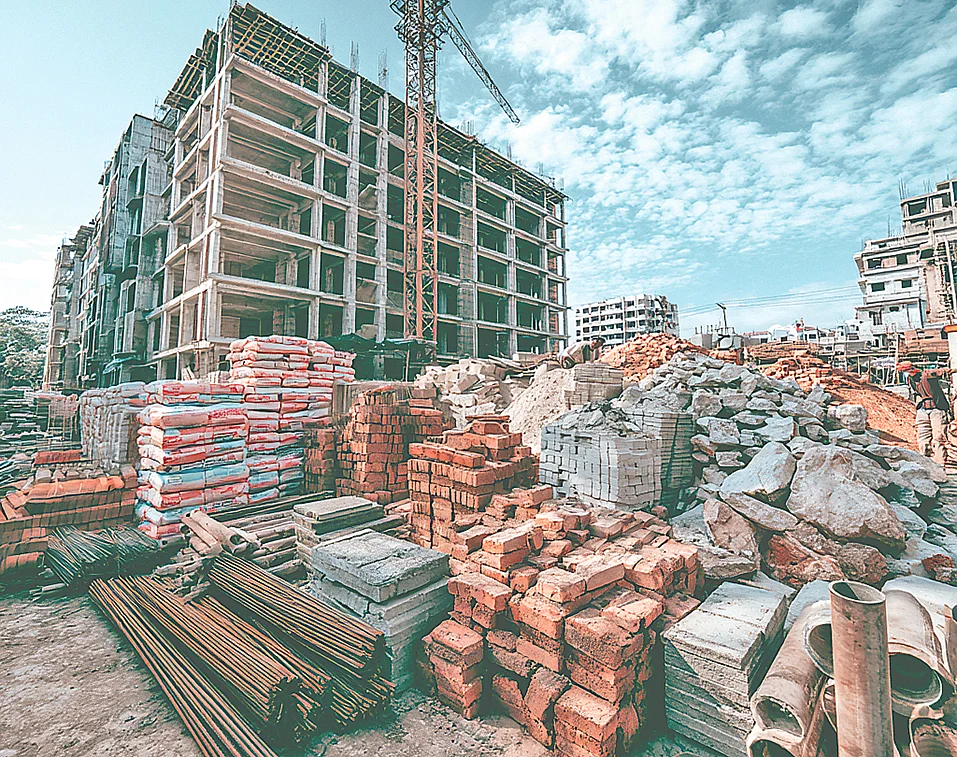
Middle-class and ordinary people are finding it increasingly difficult to realise their plan of building a permanent home on a plot of land with a lifetime of savings. Over the past year, prices of almost all key building materials, including rods, bricks, blocks, sand, stone and cement, have risen. Ordinary home builders are worried about the high cost of construction inputs. Rising import costs amid international geopolitical instability, coupled with the burden of taxes and VAT at home, have pushed construction costs up by an average of 43 per cent. As a result, many private and institutional construction projects started earlier are grinding to a halt midway.
Costs rise, ordinary people in trouble
According to businesspeople in the real estate sector and market analysts, the construction materials market has been volatile in recent times. In particular, the conflict between the United States and Israel on one side and Iran on the other disrupted global supply chains and pushed up sea freight rates, sending prices of imported raw materials sharply higher. Industry insiders estimate that global and market conditions alone raised construction material prices by about 31 per cent. Later, higher taxes and duties on backward and forward linkage industries in the budget pushed prices up by a further 12 per cent. In all, businesspeople say construction costs have risen by around 43 per cent over the past year.
A market visit last Thursday found 60-grade rods selling at Tk 90,000 to Tk 94,500 per tonne, while 40-grade rods were selling at Tk 86,000 to Tk 88,000, about Tk 10,000 per tonne less even before the construction season began.
According to the Trading Corporation of Bangladesh (TCB), 60-grade rods cost Tk 81,000 to Tk 86,000 per tonne at the same point in the season last year, while 40-grade rods cost Tk 75,000 to Tk 79,000.
In mid-2017, rods could be bought for Tk 49,000 to Tk 52,000 per tonne. Prices then rose steadily to above Tk 1 lakh, before falling back to Tk 70,000. Now they have started climbing again.
A 50-kg bag of cement currently costs Tk 480 to Tk 530. Cement manufacturers want to raise prices as the cost of imported clinker has increased from $42 to $58 per tonne, but retailers say prices are moving only slightly because demand is weak.
In the capital's retail market, coarse sand sells for Tk 35 per cubic foot, while Pakshi sand is relatively costlier at Tk 55 to Tk 60 per cubic foot. Filling sand sells for Tk 20 to Tk 25 per bag. Higher transport and supply costs have also pushed up prices of all kinds of stone.
Brick prices have risen too, as the price of coal used to fire them has gone up. First-class bricks are selling at Tk 13,000 to Tk 14,500 per thousand. Prices of ancillary materials such as stone, sand and sanitary fittings are also higher. With the construction season under way, the same goods now cost more than they did a month ago, and prices are rising almost every week.
Budgets no longer add up
Those building homes on their own initiative are the worst hit by the price rises. When an ordinary citizen starts building a two- or three-storey house, they work to a fixed budget and financial plan. But if material prices jump 43 per cent soon after work begins, it becomes impossible for a middle-class family to find the extra money.
Speaking to several home builders in Mirpur and Uttara in the capital, this correspondent found that costs have overrun budgets by 30 to 40 per cent, forcing many to suspend plastering and finishing work after casting the roof. With high bank interest rates and a rising cost of living, raising additional capital has also become difficult.
Dr Md Ali Afzal, president of the Real Estate and Housing Association of Bangladesh (REHAB), said higher construction costs have put flat prices beyond buyers' means. As a result, buyers are scarce and flat sales have hit rock bottom. Large developers, relying on their capital, are trying to complete ongoing projects even at a loss, but small and medium-sized developers have virtually collapsed.
Ali Afzal also noted that constructing a building involves about 270 local linkage industries, including rods, cement, bricks, tiles, electrical equipment and sanitary fittings. With the real estate sector in a slump, sales in those 270 local industries have fallen to less than half. If the core sector does not revive, these supporting industries will also face an existential crisis.
Demand for policy support
Industry insiders say housing, like food, clothing, education and healthcare, is a basic need. The private sector plays a major role in meeting the state's responsibility to provide housing for the country's 18 crore people. Yet even the budget for fiscal 2026-27 did not bring the policy support the sector had hoped for.
🌐 This English version was automatically translated from the original Bangla.