
Once shipped in as cement, now shipped in as raw material
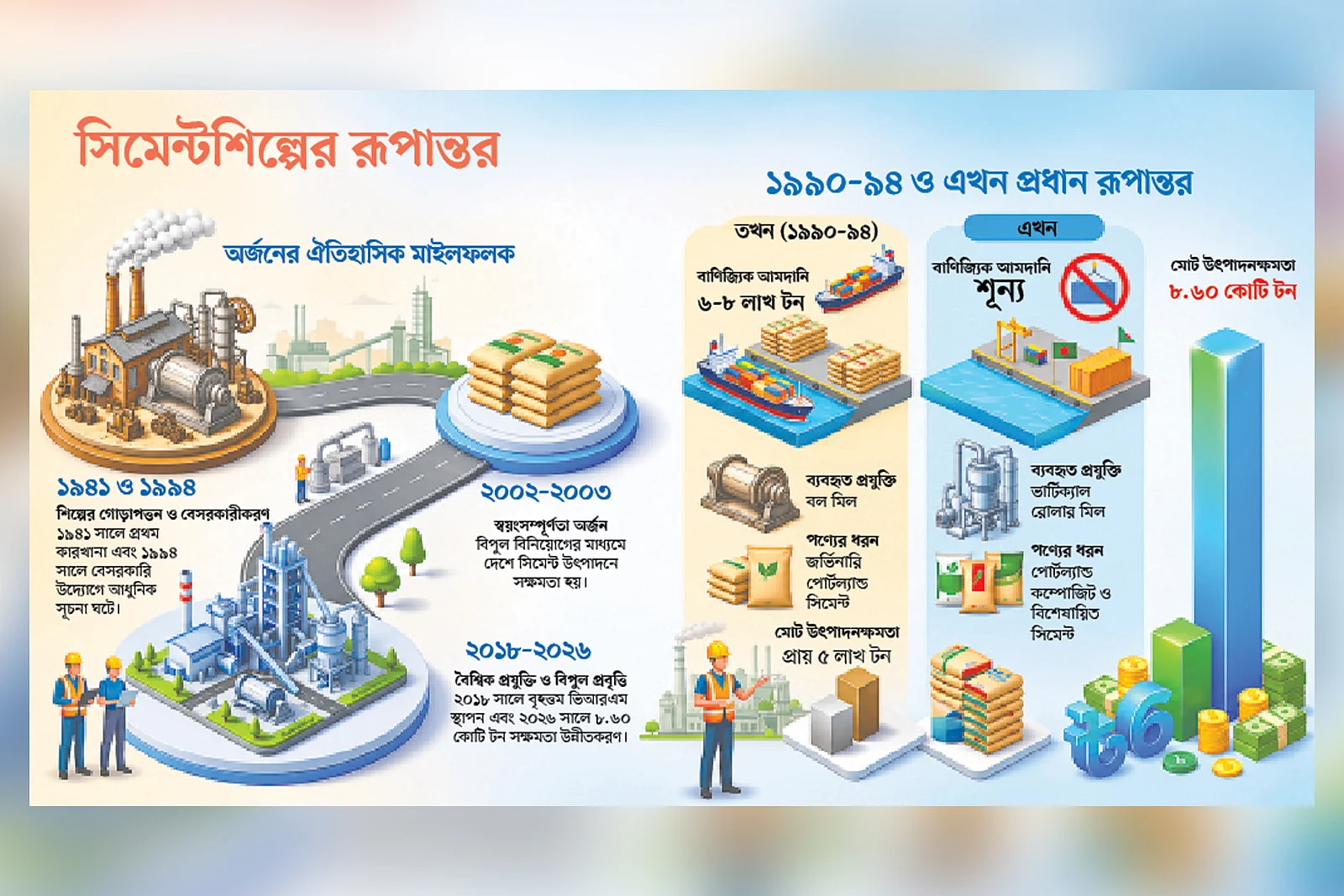
Chattogram port once unloaded sacks of imported cement from ships, and the construction material was distributed from there across the country. Ships still call at the port for cement, but what they carry has changed. Instead of finished cement, they now bring clinker, the main raw material, which local factories turn into cement.
That is how far Bangladesh's cement industry has come in 25 years. A product the country once had to import is now supplied almost entirely by domestic producers, and a limited quantity of Bangladesh-made cement is even exported.
Behind the shift lie sustained investment by private entrepreneurs, government policy support, a growing construction market and modernised production technology. Competition has changed the types of cement on offer and the way quality is controlled. A local factory also houses the world's largest cement grinding mill.
The industry's production capacity now stands at about 86 million tonnes a year, against domestic demand of roughly 40 million tonnes. A sector that depended on imports 25 years ago now has more than double the capacity it needs.
How the import picture changed
Old import figures from Chattogram port tell the story of the industry's rise. In 1999, finished cement accounted for about 8 percent of the port's bulk imports. That year, only five factories imported raw materials for cement, and imports of finished cement exceeded those of raw materials.
The picture began to change quickly at the turn of the century. In 2000, three more factories started importing raw materials. The following year, the number of raw-material importers rose to 23. Entrepreneurs were shifting from importing finished cement for the market to making it at home.
As raw-material imports through the port grew, imports of finished cement declined. According to Chattogram port data, clinker imports, the main raw material, topped 5 million tonnes in 2002, while imports of finished cement fell to just 10,000 tonnes.
By around 2002, the country had thus built the capacity to meet demand for ordinary cement. Apart from some specialised products, finished cement has not needed to be imported on a large scale since.
The change, over just a few years, was an important chapter in the country's industrialisation. Locally made cement took over a market that had relied on foreign cement.
New industry built on investment
Cement production in Bangladesh has a longer history. Assam Bengal Cement Company was set up in 1941 on the bank of the Surma river at Chhatak in Sylhet, the first cement factory in the region. After independence, it came under state ownership.
In the 1970s, the Chittagong Cement Clinker and Grinding factory was established in Chattogram, and later came under the control of Heidelberg Cement. For a long time, however, domestic production capacity was limited, and a large share of demand had to be met through imports.
That began to change in the 1990s, when private entrepreneurs started investing in cement manufacturing. Companies such as Confidence Cement, Meghna Cement, Diamond Cement and Aramit led the way.
Investment gathered further pace in the late 1990s and early 2000s. Crown Cement, Shah Cement, Fresh brand of Unique Cement, Premier Cement, Akij Cement, Anwar Cement, S Alam Cement and MetroSem entered the market one after another. Alongside local entrepreneurs, international companies such as Heidelberg, Lafarge and Holcim also invested in the sector.
Government policy played a part in the expansion. According to a World Bank study, the protective import duty burden on grey Portland cement was raised from about 36 percent to 70 percent between 1999 and 2001, making investment in domestic production more attractive than importing finished cement.
Meanwhile, urbanisation, housing construction and infrastructure development expanded the cement market. Seeing the potential for rising demand, entrepreneurs set up new factories and expanded existing ones.
Another World Bank statistic shows the scale of the investment. In 2003, the country had about 60 cement grinding plants with a combined annual capacity of roughly 12 million tonnes, though actual output was around 6 million tonnes. In other words, capacity exceeded demand from the early days of the industry's growth.
Over the next two decades, that capacity grew several times over. Large business groups expanded their investment in cement. To survive the competition, companies gave importance not only to capacity but also to product quality, technology and supply systems.
Changing types and quality of cement
The industry's transformation has not been limited to output. The types of cement and the ability to supply products to match construction needs have also changed.
Until 2001, the market mainly offered ordinary Portland cement (OPC). Portland composite cement (PCC) entered the market at the start of the new century and gradually became dominant. According to the Bangladesh Cement Manufacturers Association, PCC now accounts for about 95 percent of all cement used in the country.
Product variety also grew. Producers began marketing different types of cement to meet the needs of ordinary buildings as well as large infrastructure, industrial plants and coastal structures.
The industry also developed the ability to supply cement of specific grades and properties for large projects. Major infrastructure projects such as the Padma Bridge, the metro rail and power plants created new opportunities for the market.
Amirul Haque, president of the Bangladesh Cement Manufacturers Association, told Prothom Alo that local entrepreneurs had brought about a revolution in the cement industry. Demand is being met, cement is being exported, and world-class cement is made in the country.
In his view, the use of domestic cement in major projects after international quality checks is important evidence of the local industry's capability.
Record-setting production technology
One of the most visible changes in the industry has been in production technology. Factories initially relied mainly on ball mill technology. High-pressure grinding technology followed, and then large factories began adding vertical roller mills (VRMs). This more modern technology improves production efficiency and saves electricity.
A major milestone on this path came from Shah Cement of the Abul Khair Group. In 2018, the company installed the world's largest vertical roller cement mill at Muktarpur in Munshiganj. Built by Denmark's FLSmidth, the mill was recognised by Guinness World Records as the largest in the world.
The mill's grinding table has a diameter of 8.08 metres and its rollers 2.64 metres. The size and capacity of this single mill gave Bangladesh's cement industry special recognition in the international technology arena.
After Shah Cement, several other companies stepped up investment in modern VRM technology. Premier Cement began commercial production in July 2022 with a VRM supplied by FLSmidth of Denmark, significantly raising its daily capacity.
Most recently, in January 2026, production began at Confidence Cement's new factory at Palash in Narsingdi, using German VRM technology. The new plant has an annual capacity of 1.8 million tonnes.
This steady installation of large, modern machinery shows that Bangladesh's cement industry is no longer confined to meeting local demand. Entrepreneurs are investing heavily in global technology to improve production efficiency.
Entering export markets
Alongside consolidating their position in the domestic market, Bangladeshi producers have begun exporting cement.
The north-eastern states of India in particular have become one of the main export markets for Bangladeshi cement, and opportunities for limited exports have also opened up in several other South Asian countries.
Although exports remain very small compared with the domestic market, they highlight another aspect of the industry's transformation: the country that once had to bring in cement from abroad is now sending cement overseas.
New challenges after self-sufficiency
After 25 years of investment, the industry stands on a strong production base. But new challenges have emerged.
According to figures the Bangladesh Cement Manufacturers Association published in March 2026, the combined annual capacity of 41 factories is about 86 million tonnes. Domestic demand in 2025, by contrast, was about 39.8 million tonnes.
That means the domestic market absorbs less than half of installed capacity, so factories cannot fully use the capacity that heavy investment has created. Capacity in excess of demand opens room for future expansion, but it also intensifies business competition and cost pressures.
Another major reality is dependence on imported raw materials. Although the country can now meet demand for finished cement, most factories still rely on imported clinker, gypsum, slag, fly ash and limestone.
In 2025 too, the country imported about 20 million tonnes of clinker. As a result, rising raw-material prices on the international market, freight rates, dollar exchange rates and port and transport bottlenecks directly affect production costs.
Another challenge ahead is greener production. Worldwide, there is growing emphasis on cutting carbon emissions from construction materials. Bangladesh's cement industry will also have to pay more attention to saving energy, using alternatives to clinker and reducing its environmental impact.
There are opportunities ahead as well. Cement demand is likely to grow with urbanisation, housing and infrastructure development, and entrepreneurs can also tap expanding regional export markets.
Sacks of foreign cement once came off ships at Chattogram port. Now raw materials brought by ship are used to make that cement at home. The change over 25 years is a notable achievement in Bangladesh's industrialisation.
The industry's new goals are to make the best use of its vast capacity, to compete in international markets, and to produce more efficiently and sustainably at lower cost.
🌐 This English version was automatically translated from the original Bangla.