
Workers' protests subside, production begins in factories
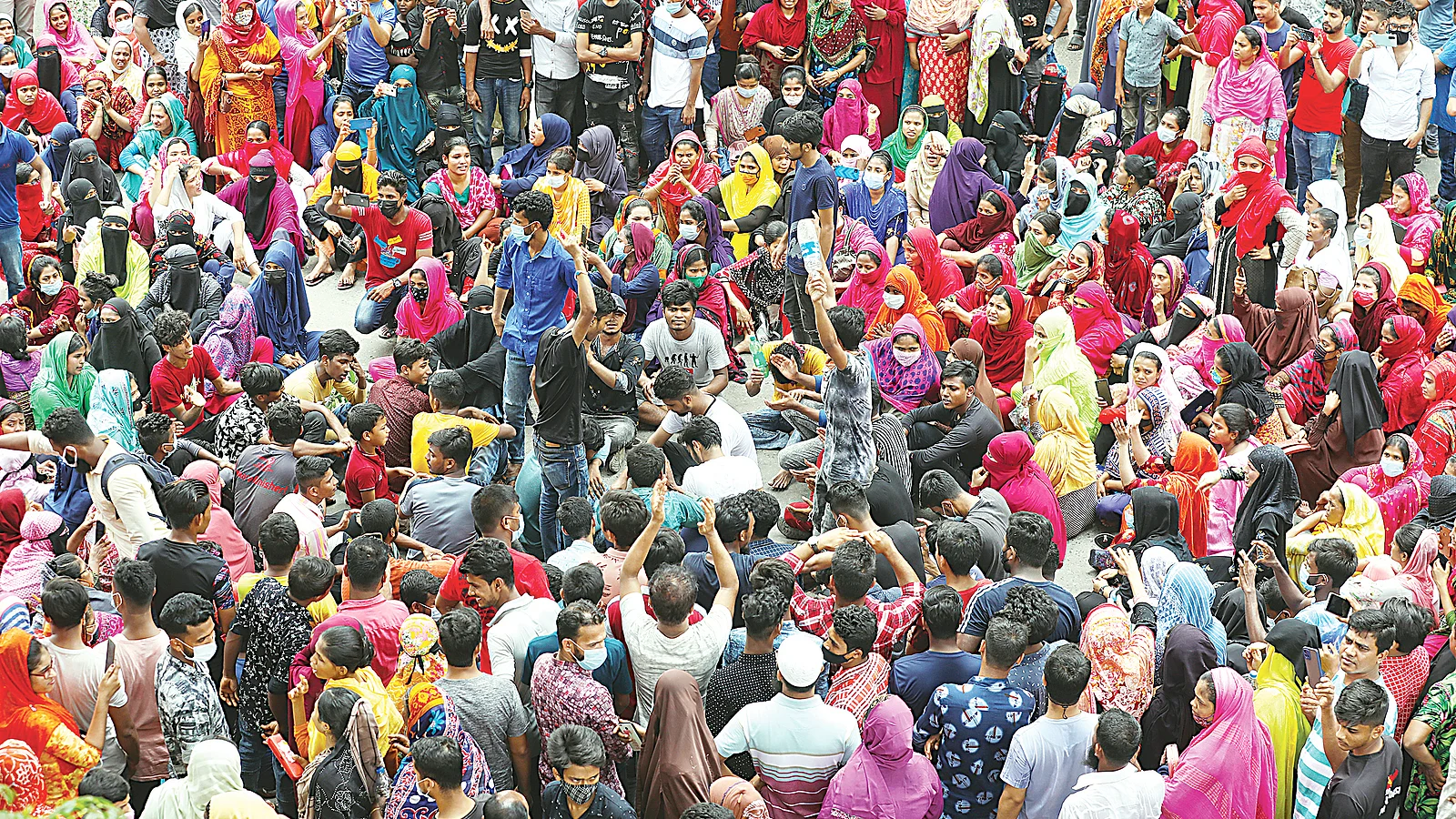
The situation in the garment industry is improving after the garment workers' agitation that lasted for more than four weeks. Production was in full swing in most garment factories in Mirpur, Gazipur and Savar areas of the capital on Saturday. However, more than half a hundred closed factories did not return to full production that day. The situation has improved a little more on Sunday. The number of closed factories has decreased.
The opening of factories brought some relief to garment industry owners in Dhaka's Mirpur, Gazipur and Savar-Ashulia. Although production has been disrupted for up to three weeks in some factories in these areas. The owners of these factories are worried about how to adjust the loss of production stop. Many industrial owners said that foreign buyers are asking for products on time. Some organizations give time but it is not enough. As a result, there has been an unusual pressure on production and shipping of goods.
According to information from the Industrial Police and Garment Manufacturers Association BGMEA, 37 garment factories in Dhaka's Mirpur, Gazipur and Savar-Ashulia were closed indefinitely on Saturday under Section 13(1) of the Labor Act. Apart from that, 12 factories were forced to give leave. And today 34 garment factories were closed. Among them are 1 in Mirpur, 22 in Gazipur and 11 in Savar-Ashulia. Apart from that, 1 factory at Ashulia in Savar gives leave.
A BGMEA official said on condition of anonymity that most of the closed factories will open on Monday.
The situation is improving. It will take another day or two to be completely normal. Those who closed factories under Section 13(1) of the Labor Act, are opening factories step by step. — —Mahmud Hasan Khan, President, BGMEA
In the last week of last month, the movement of garment workers to demand increase in wages increased. In the face of the movement, the government formed the wage board on November 1. The first meeting of the wage board was held on 4 November. Still the movement continued. As a result, the production of hundreds of factories in Mirpur, Gazipur, Savar and Ashulia was disrupted every day. 13(1) of the Labor Act from November 12 and the owners of the garment industry started shutting down the factories for an indefinite period. A day after that, the leaders of BGMEA and BKMEA jointly announced that the owners can close the factory if the workers do not work.
In the fourth meeting of the board late at night on November 24, a minimum wage of Tk 17,000 was fixed for garment workers. The wage increase is 36–43 percent across all four grades. The next day, on Wednesday, the workers' movement intensified, but on Thursday, it subsided a little. Visible improvement of the situation can be seen in the protest area since last Saturday.
Due to labor agitation this month, the production of two factories of Alps Apparels Group in Ashulia, Fashion.com and Alps Apparels, has been disrupted for 19 and 17 days respectively. 3 lakh 42 thousand pieces of clothing were not produced in Fashion.com factory. And in the case of Alps Apparels, the number is around 7.5 lakh.
When asked to know, Managing Director (MD) of Alps Apparels Group Khan Monirul Alam told \IProtham Alo\I on Sunday, "Production has been affected day after day. We have asked the buyer for more time. They agree but give very short time frame. As a result, it is challenging to send products according to that.
The production of Motex Fashion in Bordbazar area of Gazipur was stopped for five days due to the labor movement. The workers left after working half an hour for three days. Due to this, the production of 4,000 to 4,500 garments per day is disrupted in the factory.
When asked, Motex Fashion Managing Director (MD) Mohammad Masud Kabir told Prothom Alo, "We have fallen behind by two weeks due to disruption of production due to the labor movement." Couldn't ship the products of the buyer company on time. Now buyers are asking for discount or air freight. We are now negotiating the matter.'
BGMEA conducted a survey on the garment factories affected by the labor movement. In the first 18 days of this month, the production loss of 317 factories stood at 42.8 million dollars (FOB value). Apart from this, due to the instability, purchase orders worth 59 million pieces worth 25 crore 4 million dollars have gone to other countries, which is equivalent to 3 thousand Tk 175 in local currency (Tk 125 per dollar).
Mahmud Hasan Khan, president of BGMEA, an association of garment industry owners, told Prathom Alo that the situation is improving. It will take another day or two to be completely normal. Those who closed the factories under Section 13(1) of the Labor Act, are opening the factories step by step.' In response to another question, he said, 'We will hold a meeting with the representatives of foreign buyers' organizations along with the representatives of the government. We will call on the buyers to trust Bangladesh.
🌐 This English version was automatically translated from the original Bangla.