
The first international debt conference is starting in Cox's Bazar, the challenge of debt management will be important
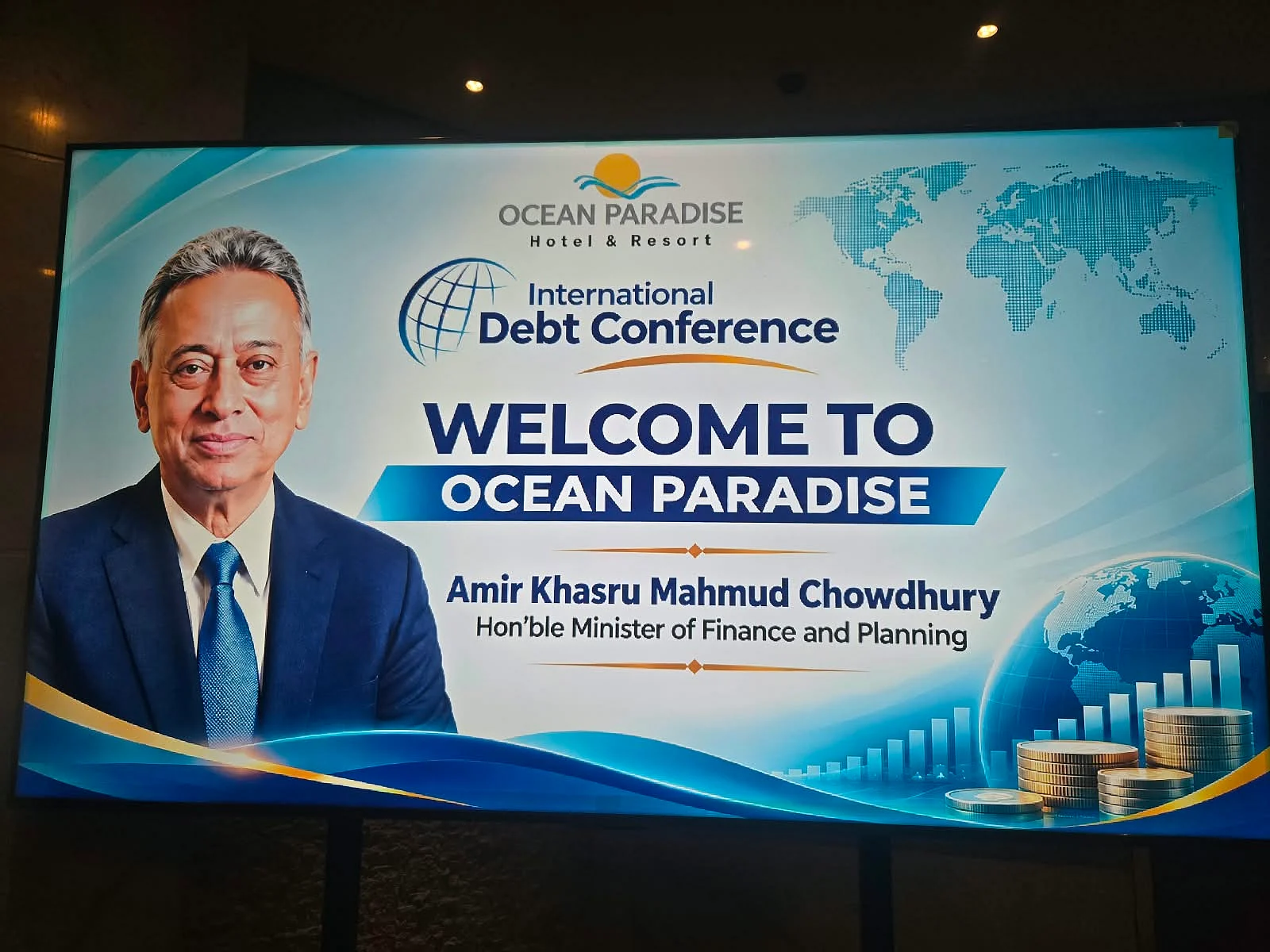
The government has organized the first international debt conference in the country with the strategy of reforming the public debt management of Bangladesh, opening the country's bond market for foreign investors and creating new sources of borrowing. The conference will be held tomorrow on November 15 and 16 in Cox's Bazar. Debt management experts from different countries and representatives of international organizations will participate in it.
The Finance Department of the Ministry of Finance has organized the conference titled 'International Debt Conference Bangladesh 2026' in collaboration with the Asian Development Bank (ADB). The theme of the two-day conference at the Ocean Paradise Hotel in Cox's Bazar is 'Public Debt Management in a Changing Global Context'. The conference will discuss the exchange of international experience and the future of debt management in Bangladesh. Finance Minister Amir Khosru Mahmud Chowdhury is scheduled to inaugurate the conference as the chief guest.
A total of seven sessions are scheduled to be held in this two-day conference. These sessions will focus on international experience of public debt management, global economic situation, borrowing strategies, local bond market development and alternative financing. Experts associated with public debt management of different countries, representatives of international financial institutions and related policy makers will participate in these discussions.
The people concerned say that the government debt of Bangladesh is constantly increasing. At the same time, the pressure of interest payment and debt repayment is also increasing. In such a situation, it becomes necessary to increase not only the amount of borrowing, but also the cost, duration, risk and management efficiency of the loan. These issues will be important in this conference. One of the important topics discussed in the conference is to develop a separate and effective framework for public debt management. For this purpose, the initiative of establishing Debt Management Office or Debt Management Office (DMO) will be discussed.
At present, the responsibility of debt management is divided among various departments and agencies of the government. There is a need for more integrated management of loan underwriting, loan data storage, risk analysis and repayment planning. DMOs play an important role in public debt management in various countries around the world. Such institutions work to analyze the overall picture of public debt, determine borrowing strategies and manage future risks. It is said that the issue of increasing efficiency and transparency in debt management by building such a structure in Bangladesh will be discussed in the conference.
Increasing the participation of foreign investors in the country's local currency bond market is also an important agenda of the conference. A major portion of Bangladesh's public debt comes from the domestic banking system and savings bonds. On the other hand, there is dependence on international development partners in terms of foreign loans. In this situation, the source of financing can increase if foreign investment in local currency government bonds can be attracted. In this regard, the responsible officials of the Ministry of Finance said that the issues of market entry and investment withdrawal opportunities for investors, transparency of transactions, currency conversion and policy stability are important. The conference is expected to discuss various aspects of creating opportunities for foreign investors to enter the local currency bond market, developing market infrastructure and removing barriers to investment.
The conference will also discuss the creation of alternative sources of government financing besides conventional loans. In this case, the possibility of different types of alternative financing methods including sukuk can be discussed. Sukuk is an asset based Islamic financial investment system. Governments can use such instruments to finance infrastructure and development projects. If alternative sources of financing can be increased, the government's opportunity to collect money will increase. At the same time, the sources of credit will be diversified and dependence on certain sources will be reduced.
The organizers said that representatives of various ministries of Bangladesh government, Bangladesh Bank, ADB, World Bank and International Monetary Fund (IMF) will participate in the conference. In addition, experts from the United States, United Kingdom, Malaysia, Indonesia, Pakistan and Sri Lanka are expected to participate.
What is the current status of debt in Bangladesh
Bangladesh's public debt is increasing, but the debt-to-GDP ratio is still not very high compared to international standards. According to the information of the Finance Department, the amount of domestic and foreign debt of the government at the end of March 2026 is about 22 lakh 59 thousand crores. Out of this, domestic debt is 12 lakh 95 thousand crores and foreign debt is 9 lakh 64 thousand crores. The debt-GDP ratio is about 40 percent. But there is more concern about the ability to repay the loan than the amount. Because the revenue income of Bangladesh is relatively low. As a result, a large part of the government's income is spent on debt interest payments.
According to Finance Department data, interest payments on public debt increased by 29 percent in the first nine months of the fiscal year 2025-26 compared to the same period of the previous year. On the other hand, if the government's borrowing from the domestic banking system increases to meet the budget expenditure, there is a danger that private sector borrowing and investment will be hindered. In the case of foreign loans, additional foreign currency is required to pay installments and interest.
According to World Bank forecasts, Bangladesh's debt-to-GDP ratio may reach 43 percent in 2026-27 fiscal year and 45.2 percent in 2027-28 fiscal year, meaning the debt burden is likely to increase further.
🌐 This English version was automatically translated from the original Bangla.