Three sectors of the country may be under pressure if US tariffs are imposed
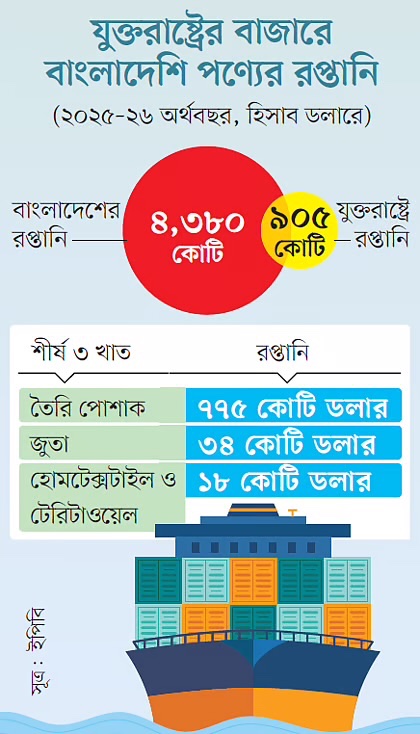
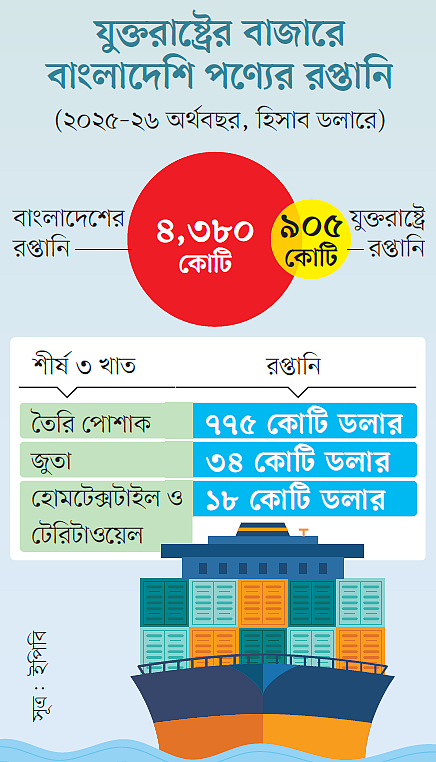
The imposition of new US tariffs could put pressure on Bangladesh's three export earning sectors—manufactured garments, footwear and home textiles and terrytowels. The entrepreneurs of these sectors are worried about this issue.
Entrepreneurs say now is the time to bargain to increase garment prices due to rising wages in the garment sector. At such a time, US buyers will not want to pay higher prices due to new tariffs. On the other hand, if the tariff rate of a competing country is lower than that of Bangladesh, they will move ahead. Pakistan is in an advantageous position in this regard. The United States has not spoken of imposing new tariffs on them.
According to the Export Development Bureau of Bangladesh (EPB), Bangladesh exported goods worth 4,380 million dollars in the last fiscal year 2025-26.
The US was the largest destination of $9.05 billion worth of goods, which accounted for 20 percent of total export earnings.
About 86 percent of Bangladeshi goods exported to the United States are ready-made garments. Apart from this, exports of footwear and home textiles and terrytowels accounted for around 6 per cent.
What is to be seen now is the rate at which the duty is finally imposed on any country.
The Office of the United States Trade Representative (USTR) on November 25 proposed to impose tariffs at various rates on the exports of 14 countries, including Bangladesh, alleging excess industrial production capacity. In case of Bangladesh this duty will be 18 percent. If negotiations and commitments are not satisfactory, the rate may be 20 percent.
The government of Bangladesh can give a written opinion on the proposal of USTR by January 5. The tariffs will come into effect after a hearing at the US International Trade Commission in Washington on January 25. Now it remains to be seen what rate of duty is finally imposed on a country.
New US tariffs on Bangladesh could be up to 18%
USTR launched two investigations against various countries under Section 301 of the US Trade Act last March. It has an excess production capacity; The other is about not properly enforcing the ban on forced labor products. Among them, 10 and 12 percent duty was imposed on 60 countries including Bangladesh, India, Vietnam, Indonesia, Cambodia, Pakistan, accusing them of not properly implementing the ban on products produced by forced labor last July. In case of Bangladesh this duty is 10 percent.
Exports of Bangladeshi goods to the US currently average a 25 percent tariff, up from the 10 percent imposed in July. If the new 18 percent duty is imposed, the total average duty would be 33 percent.
According to USTR documents, 2,207 products would not be subject to the proposed new tariffs. These products include tea, spices, vegetables, fruits, medicines, jute and handicrafts, wooden products etc. However, these products are exported from Bangladesh to the United States in very small quantities. For example, in the last fiscal year 2025-26, the export of medicine to the United States was worth 1 crore 67 million dollars.
The average tariff on Bangladeshi goods exports to the US is currently 25 percent, up from the 10 percent imposed in July. If the new 18 percent duty is imposed, the total average duty would be 33 percent.
New tariffs despite increase in imports
US President Donald Trump announced counter-tariffs on various countries including Bangladesh in April last year. In case of Bangladesh, the rate was 37 percent. Various countries negotiated and negotiated agreements with the United States to reduce these tariffs.
Three days before the 13th National Assembly elections in Bangladesh, the former interim government led by Professor Muhammad Yunus signed the Reciprocal Trade Agreement (ART) with the United States on February 9.
Donald Trump's retaliatory tariffs have been declared illegal by the country's courts. This tariff on Bangladesh last stood at 19 percent.
Meanwhile, according to the trade agreement with the United States, Bangladesh will import US LNG worth about one and a half billion dollars in the next 15 years. A minimum of 7 lakh metric tonnes of wheat per year (for 5 years), a maximum of $125 million per year or 2.6 lakh metric tonnes (whichever is less) of soybeans and soy products and cotton are to be purchased. Biman Bangladesh Airlines has signed an agreement to buy 14 Boeing aircraft.
India was Bangladesh's second largest trading partner for a long time. 16 years later that position has changed. The United States has occupied that place leaving behind India.
Imports of LNG, wheat, soybeans and cotton from the US also increased. Although there was no growth in the overall import of Bangladesh in the last financial year, the import from the United States increased by about 32 percent. 3.6 billion dollars worth of goods were imported from the United States.
India was Bangladesh's second largest trading partner for a long time. 16 years later that position has changed. The United States has occupied that place leaving behind India.
However, the United States has not yet promised to provide duty-free benefits to exports of clothing made from American cotton. Meanwhile, USTR has proposed a maximum of 18 percent, alleging excess production capacity in Bangladesh's textile and ready-made garments, cement and leather industries.
Bangladesh under the pressure of new tariffs in the US market, a five-week test ahead
What is the impact on the big three sectors?
According to several entrepreneurs in the clothing industry, the average price of oven and knitwear in the United States FOB (excluding freight) is $3.5 to $4. Many buyers have had to waive up to 1 percent or 4-5 cents FOB while the countervailing duty is in effect. Such a situation may be faced if the new duty comes into effect. A 36-43 percent increase in wages for garment workers will increase production costs by 15-20 cents per piece of clothing. Many buying establishments will not increase the price of clothes on the pretext of increased duty. As a result, Bangladesh will lag behind at least 15 cents per piece of clothing in terms of competitiveness.
When asked to know, the managing director of Sparrow Group of Industries, a leading company in the apparel sector, Shovon Islam told Prothom Alo, "We proposed to take 8-10 cents or more from many American buyers due to the increase in wages." However, this may become almost impossible due to the new tariff proposal. Because, naturally, the buying companies will justify the cost of additional duty. He said, "This will put us in a difficult situation. The duty can be reduced if the government negotiates properly.
According to EPB data, the US market exported shoes worth 340 million dollars in the outgoing fiscal year. This export is 12 percent more than the previous financial year.
Several entrepreneurs in the shoe industry said that while the counter-tariff is in effect, some US buyers are shifting purchase orders for non-leather shoes from China to Bangladesh. Some other buyers are preparing to buy shoes from Bangladesh. In such a situation, the new tariff proposal may have a negative impact.
Due to rising wages, we proposed charging 8-10 cents or more to many US buyers. However, this may become almost impossible due to the new tariff proposal. Because, naturally, the buyer organizations will justify the cost of additional duty.
Shobhan Islam is the managing director of Sparrow Group of Industries
Riyad Mahmud, managing director of Enpoly Footwear, told Prothom Alo, "In the last financial year, we exported shoes worth 38 million dollars. 16-17 percent of them went to the United States. A few new US buyers are in talks to make shoes in our factory. If these are finalised, half of our total production will be destined for the United States. The new tariff proposal may lead to a rethinking of the buyer organization. If that happens, we will be in trouble.
Exports of home textiles (bed sheets and allied products) and terrytowels (towels and allied products) were worth $180 million in the outgoing financial year. The previous year's exports were worth 165 million dollars.
M Shahadat Hossain, chairman of Bangladesh Terry Wool and Linen Manufacturers and Exporters Association (BTTLMEA) told Prothom Alo, "We cannot compete with Pakistan in low-cost home textile products in the US market. We are more competitive in higher priced products. If the new tariff is added, more orders will go to Pakistan. Our exports will decrease.
In the outgoing financial year we exported shoes worth 38 million dollars. 16-17 percent of them went to the United States. A few new US buyers are in talks to make shoes in our factory. If these are finalised, half of our total production will be destined for the United States.
Riyad Mahmood is the Managing Director of Enpoly Footwear
According to USTR data, an 18 percent tariff has been proposed on exports of goods from Bangladesh as well as Indonesia, Cambodia and Thailand. In case of India, the duty will be 17 percent. However, if the country does not have a trade agreement with the United States, the tariff may be 25 percent. In addition, tariffs on Vietnamese goods have been proposed at 20 percent. If there is no trade agreement, it can increase to 35 percent. Tariff on Chinese products is 20 percent. However, if there is no agreement, there is a fear of 40 percent.
USTR has not proposed these tariffs on Pakistan. The country is a major competitor of Bangladesh in exports of textiles, home textiles, terrytowels and denim garments.
When asked to know, private research institute Knowledge Hub Institute President Khandkar Golam Moazzem told Prothom Alo that Bangladesh should take a strong position in the hearing of USTR's proposal. On the other hand, the trade agreement signed with the United States needs to be reviewed in the current situation. Because, it is a discriminatory contract. Parliament also needs an open discussion about the agreement. He said that the tariffs that the United States is imposing one after another are against the principle of free trade. By imposing these tariffs, the country is challenging the production of products using low-cost raw materials. This weakens the export competitiveness of LDCs.
🌐 This English version was automatically translated from the original Bangla.