
Cox's Bazar's dried poppy seeds are being exported to USA, Hong Kong and China, why is there so much demand?
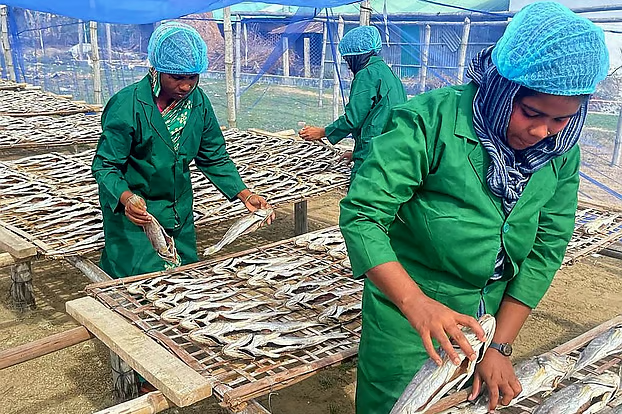
Dried papayas produced in Cox's Bazar coast are being exported to USA, Hong Kong and China. Delicious soups and food made from dried papaya are in demand in those countries. Apart from this, the dried crackers (vesicles) and fish pulp of popa fish are used to make collagen—which is in great demand in the cosmetic and pharmaceutical industries. Last year, from a factory (fish factory) in North Nuniachta of the city, 70 metric tons of dried popa fish worth Tk 6 crore were exported to three countries. About 80 metric tons are expected to be exported this year. However, due to the decrease in fish production for several months, there are fears that the export target will be achieved or not.
The country's largest dried fruit production palace has been built on the coast of Naziratek in Ward No. 1 of Cox's Bazar Municipality. Over a period of time, around 700 mahals of dry goods have been built here. Last year, at least 300 crore rupees worth of dried fruits were produced in the palaces. Various species of fish including Laksa, Maitya, Popa, Laitya, Coral, Chapa, Kamilla, Faisya caught from the sea are dried in the sun. However, the process of making popa fish shuntaki is different from other shuntaki. President of Cox's Bazar Marine Fish Production and Traders Association. Zainal Abedin said, there is a special method to produce popa shuntki that can be exported abroad. If it is not up to standard, the driers are declared unfit for export. Foreign buyers (buyers) monitor the quality of the dryers from their presence in the factory.
POPA DRYER FACTORY IS DIFFERENT
There is an exporter of dried popa fish called 'Sagar Fish Export' on the North Nuniachta coast of Ward No. 2 of the municipality. Recently visited there, some women dressed in green clothes were seen tending the popa shuntki in the bamboo loft. Some workers are taking out the salt and scales from the stomachs of raw popa fish caught from the sea and cleaning them. Some workers are letting the fish dry in the sun. Abid Ahsan, the owner of Sagar Fish Export, is supervising the drying process.
Director of Cox's Bazar Chamber Abid Ahsan told Prothom Alo that the production of popa shuntki is going on in the factory 24 hours a day. There are 30 workers there. Popa fish for export abroad is caught from the deep sea. Most poplars are caught with fishing rods. There are more than 120 trawlers fishing for popa with barashi. Out of this, 28 trawlers from Maheshkhali, Ghativhanga, Sonadia, Chauphaldandi regularly supply papa to his factory. He said that his investment against the factory including land is about 15 crore taka.
In the morning, a few fishermen from a trawler in Maheshkhali's Ghativanga brought a few popa fish to the factory. 80 percent of the fish weigh 400-500 grams. The wholesale price of papa per kg is 300 to 400 taka. Among them, popa fish preserved in ice is 300 taka, and the price of popa preserved with salt is 400 taka. After catching fish in the sea, fishermen now put salt in the stomach of popa fish instead of ice, which prevents the fish from rotting quickly.
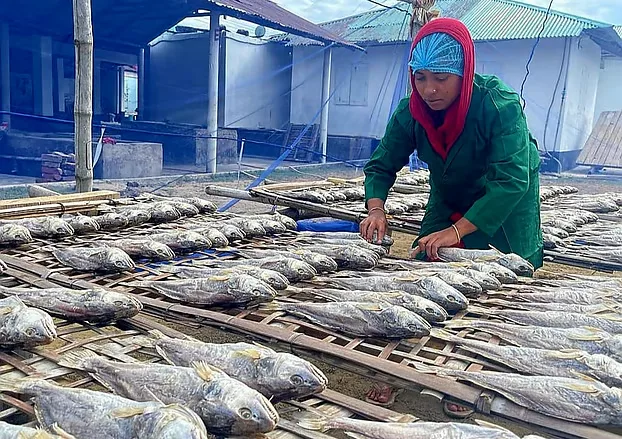
Decreasing Popa Fish
Popa fish is less caught in the sea now. Abdul Nabi, a fishing trawler sailor (Sareng), said that 60-70 km from the coast, we have to go to the Bay of Bengal and throw the barashi. Each liner (rope) has three to four thousand barashis. Barashi goes to the bottom of the sea. At low tide, aadhar (fish food) is packed in a barashi and thrown into the water. After six hours, when the tide starts, the popa fish comes to feed. In this way, popa fish is caught by staying in the sea for seven to eight days. Last year, the fishermen of this trawler caught popa fish worth 15 lakh rupees. However, in the current season, not much fish is being caught. In the last eight months, they have sold seven lakh rupees worth of papyrus.
Shamsul Alam, a fisherman of another trawler, said that 18 species of caterpillars were caught in the sea a few years ago, now 12 species of caterpillars are being caught. Among these, the black variety is sold at a higher price. Previously, trawlers used to store the extracted popa through ice. Now cut the belly of popa fish and add salt to preserve it. Because, if the pods are stored with low-quality ice, the quality of the pods will be damaged, making them unfit for export.
The process of making popa fish sauce is different from other sauces. President of Cox's Bazar Marine Fish Production and Traders Association. Zainal Abedin said, there is a special method to produce popa shuntki that can be exported abroad. If it is not up to standard, the driers are declared unfit for export. Foreign buyers (buyers) monitor the quality of the dryers from their presence in the factory.
Fishermen of some other trawlers said that many trawling vessels from Myanmar and India are seen fishing in the deep sea. Numerous trawling ships from Chittagong come to Cox's Bazar coast and catch fish. The ships drag the nets and collect all kinds of fish from the seabed. Cox's Bazar wooden trawlers cannot cast their nets in the sea because of trawling vessels. Due to indiscriminate fishing by trawling vessels, the sea is becoming fishless.
District Fisheries Officer. Nazmul Huda said that his department does not have modern vessels to monitor the indiscriminate fishing of trawling vessels in the deep sea. However, the Directorate of Fisheries with the cooperation of Coast Guard, Navy and Naval Police is conducting regular operations against the prohibited current nets, Bihindi nets.
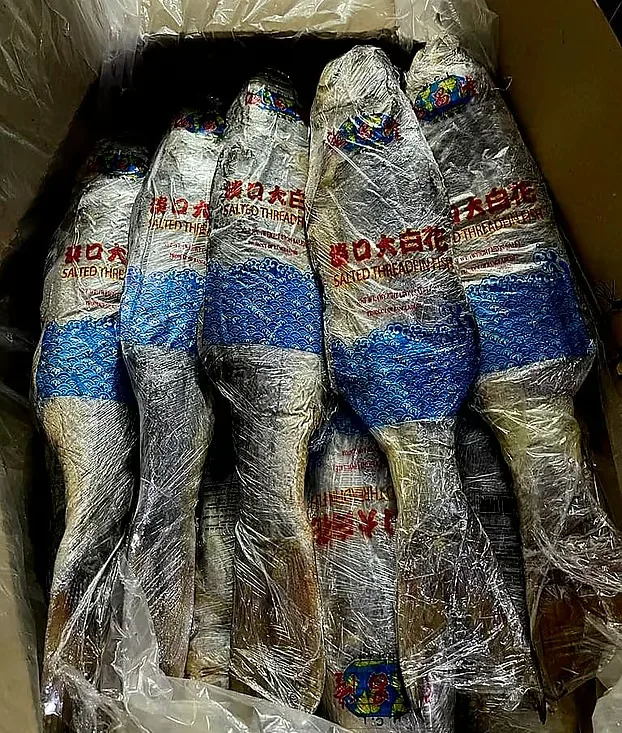
How Dandruff Forms
Recently went to Sagar Fish Export, a factory for making popa, and saw the details of making shutki. After bringing the popa fish to the factory, the workers first take out the salt from the stomach. Then the scale is thrown away and placed in the washing tank. There are six tanks in the factory. It is then allowed to dry in the sun in a bamboo loft in the open field. The fishes are turned over four times till five o'clock in the afternoon, so that all sides of the fish are properly dried. It takes three to four days to fully dry. Then packaging is done according to the grade. Then it is kept in cold storage at a temperature of 5-10 degrees. From there it is packed in cartons and sent to Chittagong Port for shipment. Popa fish is declared unfit for export if there is a disturbance in the processing. Then the losses have to be calculated. During the production of Popa Shutki, the representative of the exporting company (buyer) is present to monitor the quality of the fish. There are 32 grades of poppy seeds. Grades are determined by considering quality.
Abid Ahsan Sagar, the owner of the factory, said that if you dry three kg of raw papaya, you get about 1 kg. 16 kg of dried fruit is available in one mane. Last year, he exported 70 metric tons of dried papaya to 6 companies in the United States, Hong Kong and China, the production cost of which was Rs. 6 crore. And exported 30 metric tons in 8 months of this year. As fishing in the sea has decreased, production has also decreased. Exports are also decreasing.
Abid Ahsan also said that there is a lot of demand for popa shuntki abroad, but due to the shortage of fish, exports are decreasing. The current price of dried poppy seed is $8 per kg in the US, Hong Kong and China. Previously it was 12 dollars. The price of Popa Shuntki fluctuates daily like gold.
Apart from Popa Shuntki, there is a demand for its Aish and crackers abroad. Abid Ahsan, a businessman, said that delicious soup is made with dried papaya. In foreign hotels and restaurants, men and women can be seen eating Popa Shuntki soup. In China, dried papaya is used to make expensive medicines. Doctors call the medicine made from dried papaya as 'natural medicine'. Apart from this, expensive cosmetics are made from the collagen obtained from this fish.
So much from Popa
Apart from Popa Shuntki, its Aish and crackers are also in demand abroad. Abid Ahsan, a businessman, said that delicious soup is made with dried papaya. In foreign hotels and restaurants, men and women can be seen eating Popa Shuntki soup. In China, dried papaya is used to make expensive medicines. Doctors call the medicine made from dried papaya as 'natural medicine'. Apart from this, expensive cosmetics are made from the collagen obtained from this fish.
Abu Morshed Chowdhury, former president of Cox's Bazar Chamber of Commerce and Industries said that even a decade ago there were 27 factories producing Popa Shuntki in St. Martin, Teknaf, Maheshkhali and North Nuniyachta areas of Cox's Bazar. Due to fish crisis, losses, soft credit facilities and lack of government incentives, more than 24 factories have stopped production of popa shuntki. Fishermen are of the opinion that due to the effects of climate change, unplanned fishing, increase in fishing in illegal nets, the production of popa fish along with hilsa in the sea has decreased.
🌐 This English version was automatically translated from the original Bangla.