
From four panjabis to livelihood for 350 women: The inspiring entrepreneurial journey of Jamalpur’s Hena
Published : 29 November 2026
•
Updated : 29 November 2026, 17:25
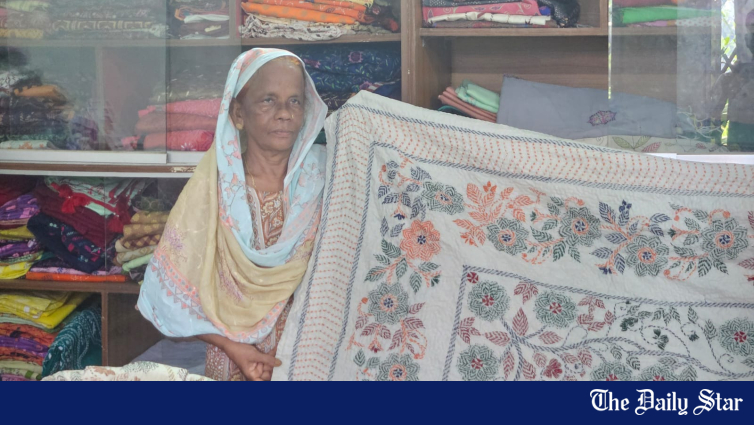
Nasimul carefully laid a sheet of tracing paper over a Rajshahi silk sari and pressed a peacock motif onto the fabric. A few village women sat beside her, watching intently. They would follow the outline with needle and thread, gradually bringing the design to life. Once completed, a peacock would unfurl its magnificent tail across the anchal of the otherwise plain sari.Made by Mohot Hosto Shilpo in Jamalpur Sadar, the sari would pass through several hands before reaching a woman in the capital with an appreciation for fine craftsmanship. Behind this intricate piece of artistry is Hena Khatun, the entrepreneur who runs the enterprise and has created livelihood opportunities for 350 women through the production of finely embroidered saris, three-pieces and kanthas.Mohot Hosto Shilpo began in 1996 with an order for just four panjabis. Today, Hena runs two factories: one dedicated to finishing embroidered garments and the other to block printing. While a handful of employees work at the factories permanently, most of the women artisans undertake nakshi embroidery from their homes across surrounding villages. The enterprise now generates an average monthly income of more than Tk 50,000.It began with an Tk 1,200 job:Hena’s two factories stand along a brick-paved road near Narikeli Bazar, about six kilometres from Jamalpur town. During a visit, she was busy showcasing saris, three-pieces and kanthas to retail customers.
At 58, Hena continues to visit the factories regularly to supervise operations. In between overseeing the work, she reflected on the hardships that shaped her childhood and ultimately set her on the path to entrepreneurship.
Born into a family struggling to make ends meet, Hena spent her early years grappling with financial hardship. In 1986, shortly after completing her matriculation (now SSC), she joined a BRAC project, earning a modest monthly salary of Tk 1,200. Though meagre, the income helped her family afford basic necessities, including food and clothing.
“My father was very poor. We had a little paddy land, nothing more. But there were eight sisters in the family, and it was extremely difficult to make ends meet. I took the job to support my sisters’ education. I got married in 1989, but I found it difficult to keep taking money from my husband and giving it to my father and sisters. So, I continued working. BRAC also provided handicraft training to women in our area, and I worked in its design section for a few years. That training eventually gave me the skills and confidence to start my own business,” she recalled.
Hena also fondly remembers her association with Sir Fazle Hasan Abed, the founder of BRAC, during those formative years.
“Abed Bhai visited Jamalpur many times. Roads were in poor condition back then. He was incredibly warm and approachable. He made no distinction between a peon, a manager or a cook. He would sit and eat with everyone. I accompanied Abed Bhai to many places. We all loved him,” she said.The first order: just four*panjabis:*Many successful businesses have emerged from modest beginnings, and Hena’s journey is no exception.
In 1996, while still working at BRAC, she received an order from an acquaintance for just four panjabis. She designed the garments herself, engaged local women to undertake the embroidery and delivered the finished products to the customer.
The four panjabis earned her Tk 3,200, she recalled. Yet, she soon recognised a significant market opportunity. Hand-embroidered panjabis made by rural artisans in Jamalpur fetched considerably higher prices in Dhaka’s showrooms, while the women behind the craftsmanship received only a fraction of the value. Determined to bridge that gap, Hena eventually left her job to pursue entrepreneurship full-time. Thus, Mohot Hosto Shilpo was born.
Her enterprise gradually established business relationships with several well-known fashion brands in Dhaka.
“For years, I produced garments for many established brands in Dhaka. They supplied the designs, and I transferred them onto the fabric and arranged the embroidery and stitching. At times, I created the designs myself as well,” she said.
The business expanded steadily, with its network of women artisans growing to more than 350 across 12 clusters. As sales increased, Hena also opened a clothing showroom in Jamalpur town. However, the Covid-19 pandemic brought business to a standstill for months, eventually forcing her to shut it down.
Rather than give up, she adapted her business model to changing market realities. Today, she sells through her own Facebook page and supplies wholesale customers with whom she has built lasting relationships.
Several online clothing retailers also source products from her factories.
“These days, I work with a wide variety of fabrics, including silk, balaka and cotton, creating intricate embroidered designs. Online retailers approach me directly for wholesale purchases, while regular customers also visit the factory to buy products at retail prices,” Hena said.
She credits BRAC Bank’s initiatives for women entrepreneurs with giving her business a significant boost, particularly by opening up access to new markets and customers.
“BRAC Bank organises the Market Enlistment Programme and TARA Uddokta Mela for women entrepreneurs several times a year. I sell garments worth several lakh taka at these fairs annually. More importantly, I have gained many regular customers through these events. They continue to purchase from me long after the fairs end. These events in Dhaka have played an important role in expanding my business,” she said.Business grows, so does her assets:Despite earning her own income for years, Hena once found herself with no significant assets registered in her name. That realisation prompted her to rethink her financial independence and take deliberate steps towards building personal wealth.
“I used to hand over every taka I earned to my husband. A few years later, I realised that all the land and property we had purchased were registered in his name. I asked him, ‘I contribute financially too, so why is nothing registered in my name?’ He replied, ‘Whatever I own will eventually belong to all of you. That is why I never thought of setting anything aside separately,’” she recalled.
Hena, however, viewed financial security differently. She had observed that many women in Bangladesh contribute to household income and family wealth but often have little or no property registered in their own names. She was determined not to remain in that position.
At one point, she decided to retain her earnings rather than hand them over entirely to her husband. She began saving systematically and investing in agricultural land and residential plots, gradually building a portfolio of assets in her own name.
Today, both factories of Mohot Hosto Shilpo stand on land that she owns, eliminating rental expenses. She has also built a house for her son.
Now approaching 60, Hena is already thinking about the next chapter of her entrepreneurial journey. She wants to modernise the business, expand its reach and take Jamalpur’s traditional craftsmanship to international markets.
Her products already find buyers overseas, particularly among the Bangladeshi diaspora. She also sees opportunities among women from other countries who appreciate and wear saris and three-pieces. “My clothes and kanthas are sold abroad too, largely because so many Bangladeshis live overseas. Women from many other countries also wear saris and three-pieces. Over the next few years, I want to establish my own direct sales channels, both at home and internationally. I want to reach a stage where other women can look at my journey and feel inspired to start businesses of their own,” she said.
From a modest order for four panjabis to an enterprise creating livelihoods for 350 women, Hena’s journey is about far more than business growth. It is a story of resilience, self-belief and the determination to turn traditional craftsmanship into economic opportunity. And perhaps her greatest achievement is not simply what she has built for herself, but the opportunities she has created for hundreds of other women to earn, grow and stand on their own feet.