
Growth will decrease, inflation will increase, people will be more stressed
Bangladesh's economy may be the slowest compared to South Asian countries; And the pressure of inflation will be the highest.
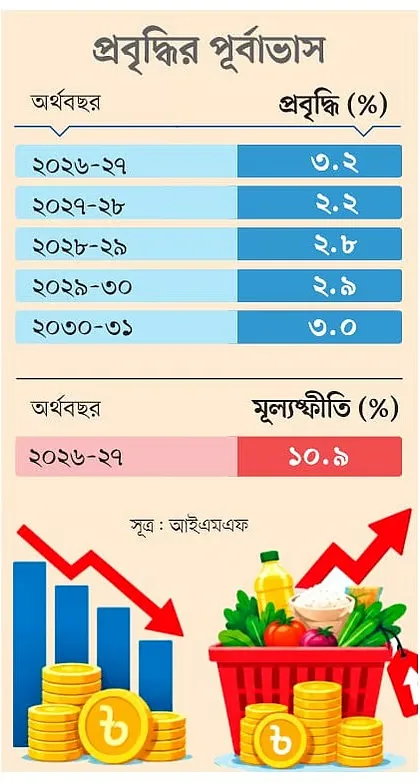
The forecast of the International Monetary Fund (IMF) says that the growth of the country's gross domestic product (GDP) may fall to 3.2 percent in the current financial year. The annual average inflation may be 10.9 percent.
There is no strong prospect of the economy turning around in the next few years. Rather, the IMF believes that the growth may come down to 2.2 percent in the next financial year. The IMF released the World Development Outlook on Tuesday. There, the GDP growth and inflation of various countries including Bangladesh have been predicted.
This slowdown in growth will increase pressure on investment and employment; And high inflation will reduce people's purchasing power. In the meantime, the World Bank recently said that about 8 million people have fallen below the poverty line in the last 4 years. About one hundred and six crore people of the country are at risk of becoming poor.
That is, the pressure of economic weakness is not only limited to the growth statistics; It directly affects people's lifestyle. A weak banking sector, energy crisis, stagnation in private investment and shortfall in revenue collection are compounding the situation. All in all, there is growing concern about economic recovery, job creation and people's quality of life.
Not only the IMF, the World Bank and the Asian Development Bank (ADB) have predicted relatively low growth. According to the World Bank's development update report published on September 6, Bangladesh's growth in the current financial year could be 3.4 percent. ADB said last month that this year growth could be 4 percent. The IMF said the growth was lower than the forecasts of these two organizations. However, the government has set a target of 6.5 percent growth in the current financial year.
In the last financial year, the growth rate was 4.14 percent according to the government. According to the IMF forecast for the current financial year, Bangladesh has not seen such low growth in the last three and a half decades. Again, the inflation forecast is the highest annual average inflation in the last decade and a half.
The annual joint meeting of the IMF and the World Bank is underway in Bangkok, the capital of Thailand. Finance Minister Amir Khosru Mahmud Chowdhury held a meeting with representatives of the World Bank there yesterday. Asked about the growth and inflation forecasts after the meeting, he told reporters that they (IMF and World Bank) have made their forecasts. Don't want to dispute their predictions. As per the target given in the budget, the work is going on.
Zahid Hossain, the former chief economist of the World Bank's Dhaka office, told Prothom Alo that the way the economy is going now, growth will be weak and inflation will be high. Various organizations including IMF, World Bank say that the country's economy is going through difficult times. Common people are under pressure, the pressure will increase further. Inflation will reduce people's purchasing power, which will increase poverty.
Growth may slow further
The IMF has only forecast Bangladesh's GDP growth and inflation. It has also forecast growth for the next four fiscal years. According to forecasts, growth may fall to 2.2 per cent in fiscal 2027-28, which is lower than the growth during the Covid period. It has forecast growth of 2.8 percent and 2.9 percent respectively in the next two fiscal years; And in the fiscal year 2030-31 it may increase to 3 percent. That is, the economy will not be very strong in the next three years.
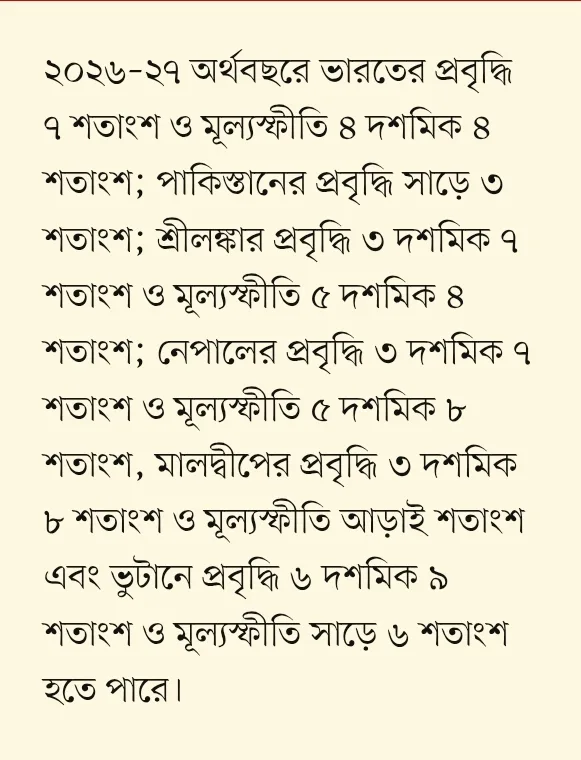
In the report published yesterday, the IMF has also forecast the GDP growth and inflation of other countries in South Asia including India, Pakistan, Sri Lanka. According to the report, India's growth in FY 2026-27 is 7 percent and inflation is 4.4 percent; Pakistan's growth is 3.5 percent; Sri Lanka's growth is 3.7 percent and inflation is 5.4 percent; Nepal's growth is 3.7 percent and inflation is 5.8 percent, Maldives' growth is 3.8 percent and inflation is 2.5 percent and Bhutan's growth is 6.9 percent and inflation is 6.5 percent.
What is risk in economics
The IMF report did not mention any analysis or challenges of the Bangladesh economy. On September 6, the World Bank Bangladesh Development Update October edition analyzed the economy of Bangladesh.
According to the World Bank report, several pressures have been created in the country's economy. Growth is slowing, investment and employment are weakening, inflation is driving down people's real incomes. Along with this, the weakness of the banking sector, energy crisis and fiscal deficit are increasing the risks of the economy. The World Bank has identified the weakness of the banking sector as one of the biggest risks to the economy.
According to the World Bank, the poverty rate has increased due to many factors including high inflation, decline in real income, decline in employment. In the last 4 years, about 8 million people have fallen below the poverty line. In the last financial year, about 21 lakh people have again fallen below the poverty line. The national poverty rate also rose for the fourth year in a row. In 2022, this rate was 18.7 percent. In the last financial year, it has increased to approximately 22.5 percent. In the current financial year, it may increase to 22.8 percent. At the same time, income inequality has also increased.
The World Bank considers the weakness of the banking sector as one of the risks to the economy of Bangladesh. At the end of December 2024, the default rate was 20.2 percent. In June 2026, it increased to 33.2 percent.
The World Bank said credit growth in the private sector was the slowest in 33 years. Many factories have produced below capacity due to gas and electricity shortages. Some companies have reduced working hours, stopped production or laid off workers. Foreign investment fell by 15 percent last year.
The government had to spend several billion dollars to import fuel oil. Again there is not much progress in revenue collection. The National Board of Revenue (NBR) is not able to collect the desired revenue. In the first two months (July-August), the shortfall in revenue collection exceeded Tk 25,000 crore. In this way, various pressures have been created in the economy.
Economist Zahid Hossain said in response to the question of what should be done to overcome the situation, inflation should be brought under control. Obstacles to growth and employment must be removed. Obstacles include weak banking sector, energy crisis, chaotic budget management, inadequate social protection programs. Reforms are needed in these matters.
🌐 This English version was automatically translated from the original Bangla.