
Why are the sellers in trouble with the 5 crore rupees in Cox's Bazar?

There are at least 45 shops in Cox's Bazar's Nazirertech Shuntki Bazaar. In the shops, there are various types of knives including knives, laitya, maitya, popa, surma. According to traders, the market now has dry stocks worth at least five crore rupees.
But there are no buyers. In the shop where earlier dried fruit was sold for Tk 50 thousand a day, now the sale has come down to Tk 3 to Tk 3500. Due to reduced sales, many businessmen who are doing business with bank loans are in financial crisis.
Such a picture can be seen when visiting the dry market of Nazirertek last Wednesday afternoon. As there were no customers, the shopkeepers were spending idle time. Some were sitting, some were listening to music. Traders say that tourists visiting Cox's Bazar are one of the main buyers of their dry goods. But as various parts of the road leading to Nazirrate are dilapidated, tourists are not interested to go there. Along with this, the crisis of fish in the sea and the decrease in the production of dry goods increased the business recession.
On the west side of Nazirertek road, the shop called 'Fish Market' has various types of dried fish hanging. There, per kg knife dried Tk 900 to Tk 3000, Laitya Tk 700 to Tk 2200, Maitya Tk 1800 to Tk 2500, Popa Tk 600 to Tk 900, Surma Tk 1000 to Tk 2500, Lakshya Tk 2500 to Tk 3000, Shrimp Tk 500 to Tk 1300, Kamila Tk 800 to Tk 1000 and small fish dried Tk 300 to Tk 600. Selling for Rs.
The manager of the store. Farooq (38) told Prothom Alo that his shop has about seven lakh rupees worth of dry goods. But sales are very low. Earlier, 50000 taka per day was sold but now only 3 to 3.5000 taka is being sold. If tourists don't come, the sale of dry goods does not increase.
The store called 'Shutki Market' also has a stock of about 12 lakh Tk. The owner of the shop. Mojibur Rahman said, considering the shortage of dried fruit in the market, he had saved a large amount of dried fruit. But not getting the expected response from the tourists. Some local businessmen buy wholesale dry fruits from his shop and sell them retail to different shops in the city. This increases the price from Tk 100 to Tk 300 per kg.
Similar is the case with Shuntki Plus, Shah Jabbaria Shuntki Bitan, Allandan Shuntki Aarat, Shuntki Mart and other shops in the market. Each shop has dry stock worth Tk 7 to 20 lakhs. But it is not selling because there are few buyers. Azizur Rahman, the owner of a shop, said that he had stockpiled money with a bank loan. Now, due to non-sale, he is in trouble with running the business expenses including debt repayment.
According to the traders, one of the obstacles to the travel of tourists in Nazirrate is the bad condition of the roads. On the way from the city to Nazirrate, about two kilometers of roads are broken in Samitipara, Kutubbazar and West Kutubdiapara areas. They claim that even 15 days ago, some shops were selling dried fruit worth Tk 50,000 to Tk 2 lakh a day. Now it has reduced from 3 thousand to 20 thousand taka.
Cox's Bazar Municipality Administrator and Deputy Director of Local Government Department. Shamim Al Imran told Prothom Alo that it is not possible to fix the broken part of the road with municipal funds. Initiatives are being taken to rehabilitate the road with funding from the World Bank. Survey work has already been completed. Renovation work will be started soon if financial assistance is received.
Production stopped at 600 Mahal
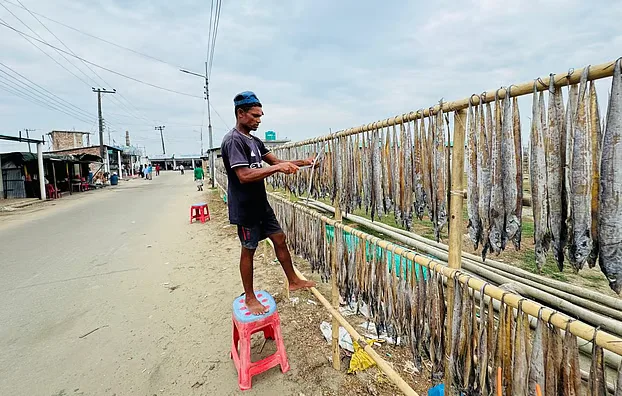
In addition to the decline in sales in the dry market, production is also slowing down. More than 600 shuntki mahals on the coast of Nazirartek of Ward No. 1 of Cox's Bazar Municipality have stopped production, said the concerned persons. According to them, fish is not being caught in the sea as expected for more than six months. Meanwhile, the situation has worsened due to government restrictions on fishing. In this, the livelihood of about 30 thousand dry workers and about 120 thousand fishermen and workers associated with 6 thousand trawlers has come under pressure.
Around the area, a small amount of knife fish can be seen dried to make shunkki in three palaces. The workers said that these fish were bought from Fishery Ghat in Chittagong before the ban started. Later stored in freezer. Now they are dried in the sun.
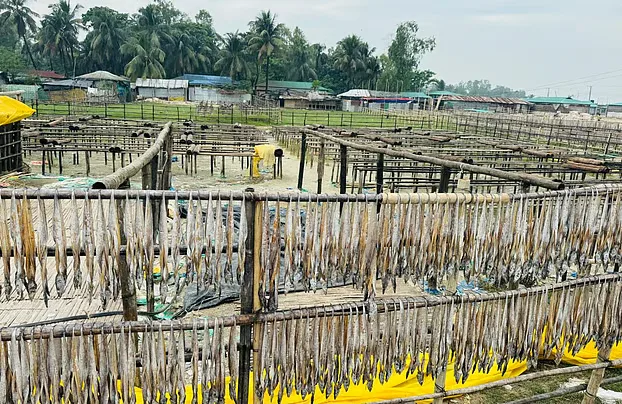
One of the functioning palaces is 'Rashed Shuntki Mahal'. Going there, it can be seen that more than 60 bamboo lofts are lying empty. Some fish are being dried in only two lofts. A woman and five children and teenagers are working. The owner of the palace. Rashed said that earlier more than 40 workers were working in his palace. Only a few are working now. Male laborers get Rs 800 and women Rs 500 to 600 per day. Most of the workers are unemployed due to the shutdown of production.
Many laborers of Shuntkipalli in Nazirrtek lost their homes due to climate change and took shelter here. One of them is Sara Khatun (45). He has been working in Shuntki Mahal for 25 years. After the death of her husband, she took responsibility of the family with four daughters. The elder daughters are married. A girl returned to her mother with her child after separating from her husband. Mother and daughter worked together in the palace and earned 1000 taka a day.
But in this month of October, the mother and daughter got only four days of work. Their total income is four thousand rupees. Sara Khatun said, this money is not enough for 10 days of food. If they don't get work, they have to go without food.
Akhtar Kamal, the former councilor of ward number 1 of the municipality, said that even in the peak season, more than 600 mahals of Nazir Tek are closed due to the shortage of fish in the sea and government restrictions. About 30,000 people, including more than 12,000 women workers, have lost their jobs. On the other hand, due to broken roads in Samitypara and Qutub Bazar, tourists are not able to go to Nazir Tech shops and buy shuntki.
Production falls, fears of more crisis ahead
President of Cox's Bazar Dry Processed Traders Cooperative Association. Zainal Abedin said, fish is not available in the sea as expected. This is disrupting the production of dried fruit in more than 600 mahals along various coasts including Nazirartek, Nunyarchhata, Magchitapara. Last year, more than 400 crore rupees worth of dried fruits were produced in the palaces. In the first 10 months of this year, about 200 crores worth of dried fruit has been produced. If there is no fishing in the sea, the dry production may collapse further.
According to the information of the District Fisheries Department, in the first eight months of the current financial year (July-February), more than 31 thousand metric tons of dried fish have been produced in Cox's Bazar. The amount of dried fruit produced in 12 months of the previous financial year was 48 thousand 285 metric tons.
District Fisheries Officer Nazmul Huda believes that the availability of fish has decreased due to various reasons including the effects of climate change and overfishing in the sea. He said that it is important to comply with the government ban for the sake of conservation of fisheries resources. However, due to the shortage of fish, the production of dried fish is decreasing. Why this crisis is being created is being investigated.
🌐 This English version was automatically translated from the original Bangla.