
One lakh people are employed in the two industrial estates of Bogra
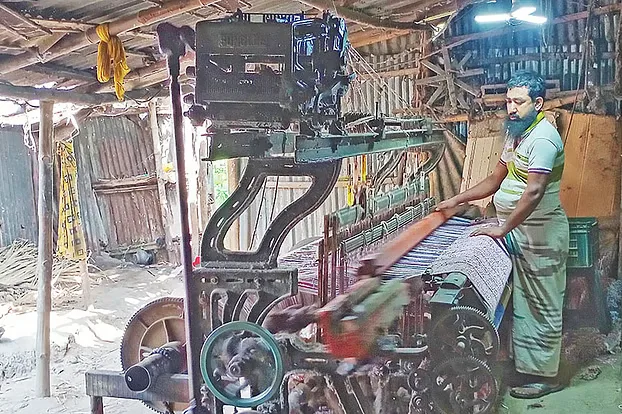
The 16 villages of Shaoil Bazar area of Adamdighi Upazila in the northern district of Bogra are like an industrial village. The whole of this industrial area is dependent on handloom industry. Various types of cloth including blankets, sheets, socks are made here. And another type of industry has developed in Bogra Sadar. Various types of light engineering (light engineering) equipment are being made here.
According to data from the Small and Medium Industries (SME) Foundation, Bogra's light engineering industrial park has an annual turnover of around Rs 2,000 crore and textile industrial park has an annual turnover of over Rs 700 crore. In total, about one lakh people have been employed in these two industrial areas.
Along with the potential in these two industrial areas, there are also challenges. Small entrepreneurs have long gone through various problems including financing, marketing and market linkages. But now the situation has changed a lot. Because, SME Foundation has identified special clusters (clusters/villages) with these entrepreneurs. It made getting loans easier; Other benefits are also available.
Textiles from Textiles
Once upon a time the weavers of Adamdighi used to make sarees, towels etc. using cotton, silk etc. yarn and sell them in the local market. By the end of the nineties weavers turned to woolen yarns and products. Later, the entire business environment was built around it.
Adamdighi's weaving industry or handloom cluster is mainly centered on the local Shaoil market. There are two types of business here – yarn and handloom products. There are six to seven thousand weavers and one and a half thousand yarn traders in this cluster. Apart from this, about 20 thousand other workers are involved in spinning, bobbin (on which the yarn is twisted) and other related industries. According to the SME Foundation, this cluster provides direct and indirect employment to around 60,000 people in total.
The yarn traders first bought jhut cloth from various garment factories in Dhaka, Gazipur, Savar and Narayanganj. 100 to 120 tons of jute cloth comes to this upazila a day. Then these yarns are separated according to type and color and they are bobbin with the help of kunning machine. This work is done by a group of workers. However, not all colors of yarn are available from Jhoot cloth as per the demand. For this, the traders sent the yarn to Dhaka and brought it for dyeing. Traders said that more than 50 types of yarn including cotton, acrylic, Chanel (chenille), moshian, tamu, wool, PVT are available in this market. Depending on the type, these yarns are sold at Tk 150 to Tk 600 per kg. In this, a trader gets a profit of 10 to 12 taka per kg.
Local weavers bought the yarn made from Jhut. Then blankets, bed sheets, towels, bed sheets, blankets, socks, mufflers are made with this yarn. People related to the sector said that the weaving industry of Adamdighi is mainly focused on the winter season. Every year in winter 20 lakh blankets, 1 crore sheets, 50 lakh towels and towels are produced here.
Apart from the local market, these products are sold in different parts of the country including Dhaka, Chittagong, Sylhet, Rangpur, Sylhet. Apart from this, various government offices, companies, non-governmental organizations (NGOs) and individual buyers also buy various winter clothes from here. A large part of the blankets that are distributed to low-income people across the country during the winter are made here.
Along with the possibilities, local traders and weavers also mentioned some obstacles. In recent years, the price of raw materials and Jhoot has increased. Because of this, the cost of local traders and weavers has also increased. Traders mainly purchase raw materials through middlemen. They said that if the raw materials were brought directly from the factory in Dhaka, the cost would be reduced. The price of loom products could also be reduced. Apart from this, most of the weavers in Shaoil area use handlooms or handlooms. It takes three people 45 to 50 minutes to make a blanket on a handloom. In this way 10 to 12 blankets can be made per house per day. There 25 to 30 blankets can be made daily on the power loom. As a result, the income is also doubled. Mozammel Hossain, president of Shaoil Bazar Handloom Cluster Association, said that not everyone can afford to buy a power loom for one and a half to two lakh taka. So many weavers would have been able to buy it if they got financing or credit facilities on easy terms.
BIG POTENTIAL IN LIGHT ENGINEERING
Various types of agricultural machinery and light engineering industries of Bogra now have a wide reputation in the country and abroad. Businessmen said that about 80 percent of the country's annual demand for agricultural machinery is met by machines made here. The journey of this light engineering industry in Bogra began with the hands of a few artisans working as sarai (repairing) in Kamarshala. That was in the forties of the last century. Bogra Sadar area now has 500 workshops for manufacturing agricultural components, 500 for other light engineering products and 75 foundries. Apart from this there are thousands of workshops for repair and maintenance of agricultural machinery. These factories are scattered around Bogra city and suburbs. About 2000 kinds of tools and parts are made here. These include centrifugal pumps, irrigation pumps, tube wells, PT chain covers, fuel pipes, oil catchers, air cleaners, silencers, chain covers etc.
Ariful Islam, the owner of AP Metal Industry, built the factory in 2018 with a capital of only seven lakh rupees. Currently, the annual income of this organization is 12 crore rupees. Products manufactured by his company are being supplied to 55 districts of the country. There are more successful businessmen like Ariful here. Bogra's agricultural machinery and light engineering industries are also creating markets abroad. According to SME Foundation, Bogra's agricultural machinery industry entered the foreign market in 1995 by exporting centrifugal pumps to India.
Golam Azam, president of Bogra Lighting Engineering Foundation, said, "If Bogra is made an economic zone for light engineering industry, our electricity and gas problems will be solved. It will reduce the cost of production, export abroad will also increase.
Being a heavy industry, bank loans are often required. But high interest rates are another problem. Businessmen claim that to make more modern machines, it is necessary to arrange interest rates below 10 percent and on simple terms.
SME Foundation Chairperson Mushfiqur Rahman told Prothom Alo that branding and product diversification of SMEs like Bogra's handloom and light engineering industries need to be increased. At the same time, they need to modernize their product manufacturing process. If this is done, the industry will become a potential sector in the economy of both countries in the next three-four years.
🌐 This English version was automatically translated from the original Bangla.